Dwight Howard bid worth it for Warriors

Decrease fontDecrease font
Enlarge fontEnlarge font

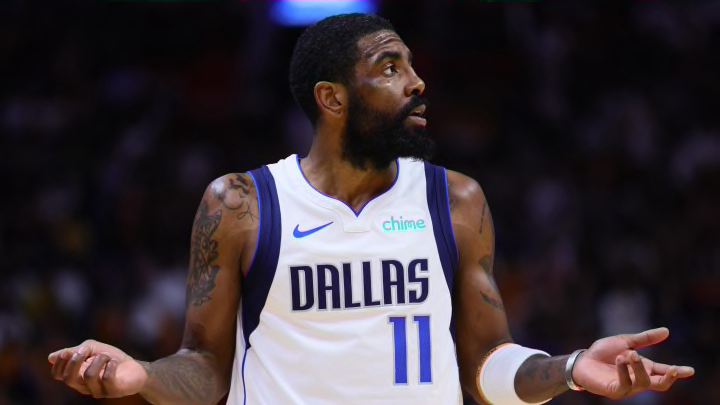
Dwight Howard has yet to add the Warriors to his wish list, but Golden State still is willing to pursue the pending free agent. (Marcio Jose Sanchez/AP)

Scott Howard-Cooper of NBA.com reported it on Tuesday, and a source familiar with Golden State’s thinking confirmed it on Wednesday with SI.com: The Warriors, on pace to make the lottery again, are willing to trade for Magic center Dwight Howard without assurances that he would sign an extension or even opt in for just the 2012-13 season, the last year of his contract.

SI.com’s Sam Amick reported over All-Star weekend that Howard still prefers the Nets, who could have max-level cap room even if Deron Williams exercises his player option for next season. The Warriors will not have max-level cap room, in part because they already used their amnesty provision on Charlie Bell’s $4 million deal for this season. Had the Warriors saved amnesty for Andris Biedrins’ $9 million 2012-13 salary, they could have had enough space (barely) to offer Howard a maximum contract this summer.

Of course, such cap space wouldn’t matter if Howard really doesn’t want to head to one of the NBA’s biggest markets and play before one of the league’s loudest fan bases. The Warriors have never been on Howard’s short list, but there is no way of knowing for sure whether he’d really bolt after a few months of living in the Bay Area, being the undisputed top option, possibly playing with Monta Ellis (whom Howard has publicly praised), working under first-year coach Mark Jackson (and minority owner Peter Guber, a movie producer) and seeing exactly what the franchise has to offer.

This is an interesting calculated risk by the Warriors in a lot of ways. I suspect the final risk/reward result favors this kind of bold move, mostly because it’s clear now that this Warriors nucleus is not a contender and won’t morph into one without outside help.

Unfortunately, building a deal without the assistance of a third team would be difficult because the Magic will surely want to unload at least one bad contract (Hedo Turkoglu’s) along with Howard, and the Warriors lack the cap space or salary-matching assets to make that happen. The Magic would be wise to steer clear of David Lee’s contract ($57.1 million in the next four seasons after this one) as a salary-matching tool in a trade that would include Ellis or Stephen Curry, one of whom would be the centerpiece of any Golden State offer. And Biedrins’ deal ($18 million over the next two seasons after this one) is just as toxic as Turkoglu’s. But you can build three- and four-team trades, and the Warriors are right to try.

As we noted on Tuesday, any team that deals for Howard before the March 15 trade deadline can offer him about $10 million more in combined salary over the next six years than a team that signs him as a free agent. It’s worth it for the Warriors to gamble that $10 million plus all the nice things about the franchise and Bay Area might be enough to entice Howard — especially when you’re in the netherworld of NBA mediocrity, as Golden State is now.

Jackson came to Golden State vowing to make the playoffs and improve the team’s defense. But the only improvement so far has actually come on offense, where Jackson has the Warriors playing at a slower pace and scoring more efficiently. Golden State ranks sixth in points per possession, up from 11th last season, mostly because it is shooting more three-pointers (as a percentage of total shot attempts), getting to the free-throw line a hair more often and assisting on a higher percentage of its baskets. Ellis has never shared more, rookie Klay Thompson and Brandon Rush (who is shooting a league-leading 52 percent from deep) have helped space the floor and Lee improves just a little offensively each season.
Defensively? The Warriors stink, in the same ways in which this group has always languished. They’re 27th in points allowed per possession after finishing 26th last season. They’re 28th in defensive rebounding rate after finishing last in 2010-11. Only one team sends opponents to the foul line more often; only one team did so last season. This team just can’t defend or clean the glass.

While it’s tempting to suggest more playing time for Ekpe Udoh and his monstrous plus/minus numbers, it’s hard to believe that the second-year big man alone would improve the Warriors enough defensively to change the long-term outlook. For one, Udoh has been a limited offensive player with unreliable range outside the paint. He is shooting 41.5 percent, hasn’t shown much as a pick-and-roll threat and barely gets to the line. It’s hard to play guys like that 36 minutes per night over the long haul. Udoh is almost 25, so it’s unclear how much more there is here. And as good as he is against the pick-and-roll and as a roving defender, he hasn’t been much of a rebounder, and lineups that feature the Lee/Udoh front-line combination have been wildly inconsistent defensively.

One note on that defense: It’s been popular among Golden State fans to hold up the team’s 2-6 record in games decided by three points or fewer as evidence that with better luck, this club could be in the playoff race. Perhaps. But dig into the clutch numbers at NBA.com, and you’ll find that Golden State has suffered in the clutch because it is surrendering points — and especially free throws — at a ridiculous rate. The Warriors have allowed 118 points per 100 possessions during the last five minutes of close games (which have a scoring margin of five or fewer points in that time range), according to NBA.com. Only Phoenix and Milwaukee have been worse. Golden State’s offense has actually produced at an above-average rate in crunch time.

The numbers get worse if you isolate games in which the Warriors trail or are tied in the final minutes, stretches in which they have surrendered foul shots at such a high rate as to basically break NBA.com’s stats database. When the unit that fails you for the first 45 minutes of a game also fails you in the last three, is it really bad luck?

Howard is the best defensive player in the league and perhaps the second-best player in the NBA overall. He is a franchise-changing force, and breaking up a franchise in this condition to get him is not an enormously risky move.

The Magic will obviously start off by asking for either Curry or Ellis if these trade discussions ever happen. This is where it gets tricky for Golden State. Again, dealing one of these players for Howard only to see Howard leave this summer would hurt, but it would not be a fatal blow considering the overall state of the franchise. The risk comes in deciding which guard to give up.

Six months ago, the easy answer would have been Ellis. He’s 2½ years older than Curry with a long track record of questionable shot selection, below-average three-point shooting and fundamentally unsound defense. But the 26-year-old Ellis has shown a bit of adaptability on offense this season and he’s been a monster in the clutch. Meanwhile, Curry has sprained his surgically repaired right ankle three times after several other sprains last season. He recently sprained a ligament in his right foot. The injuries have reached a point where you can imagine the nightmare scenario of keeping Curry over Ellis only to discover you have chosen a player who will never be fully healthy.

Curry’s health concerns could turn off the Magic, who might justifiably prefer whatever package New Jersey could offer over Ellis (owed $22 million over the two seasons after this one), Udoh and other potential assets in a theoretical deal that sends Howard to Golden State. If the Magic do prefer Curry, his low salary ($3.1 million) makes the salary-matching gymnastics that much harder.

All of which is to say: It would be very, very difficult for the Warriors to pull this off. But it’s worth a try.

  • Published On 1:11pm, Feb 29, 2012