Wolves playing chicken with Kevin Love


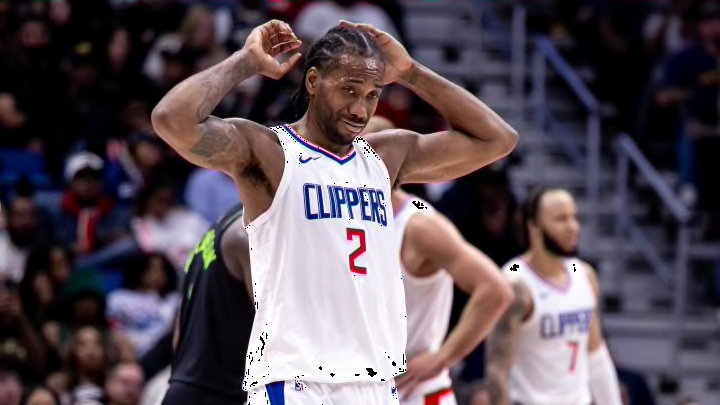
Minnesota reportedly plans to offer Kevin Love a four-year, $60 million extension. (Greg Nelson/SI)
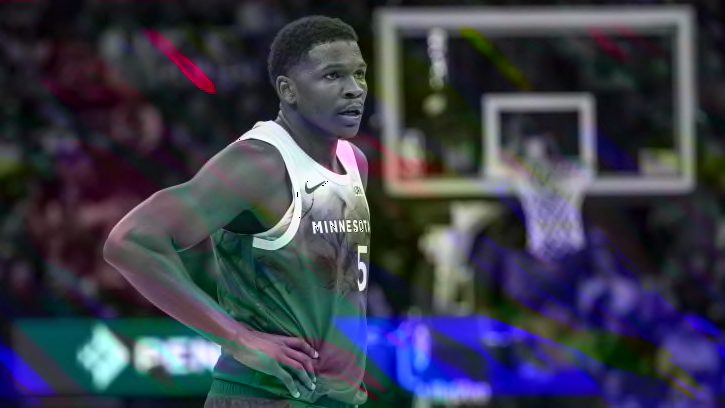
Teams have until Jan. 25 to sign fourth-year players to contract extensions, and the Timberwolves are prepared to offer Kevin Love a four-year, $60 million contract, according to Charley Walters of the Pioneer Press. This is not the most the Timberwolves can offer Love, and that fact alone raises serious questions about what exactly Minnesota is dithering over. But there are fair answers to those questions, and it is the responsibility of general managers to hoard every dollar and maintain as much future flexibility as possible.
The Wolves can offer Love a five-year deal worth around $80 million, depending on the league’s precise revenue projections. They alone can offer Love that fifth season under a provision of the league’s new collective bargaining agreement that allows a team to label one player coming off a rookie contract — as Love is — their “designated player,” and to offer that player an extra year. It is one of many small ways the NBA tried to give incumbent teams an advantage in re-signing their own players. The Bulls gave Derrick Rose that extra fifth their when they recently signed the MVP to a new extension.
The maximum any rival suitor could offer Love would be a four-year deal starting at the maximum — 25 percent of the total team salary cap, with 4.5 percent annual raises. That would likely amount to something very close to the four-year/$60 million structure the Wolves are reportedly prepared to offer, depending on again the league’s future revenue. Love will be a restricted free agent, meaning the Wolves could match any such maximum offer sheet Love might sign with another team.
And that’s one key reason we shouldn’t get on the Wolves too much for nickel-and-diming things when it comes to a power forward clearly worthy of a maximum-level deal. They can act with confidence, knowing they will be able to match any competing offer Love signs, and if the Pioneer Press report is correct, the Wolves are offering essentially the equivalent amount of that theoretical offer sheet. The only risk they really run here is in alienating Love to the point where he does the unthinkable: sign a one-year qualifying offer for $6.1 million (the minimum Minnesota must offer to retain those precious matching rights) and then become an unrestricted free agent after next season.
That is a threat Love and his agent, Jeff Schwartz, may hold over the Wolves in order to snag that fifth year, but it’s not an enormously powerful one. Accepting a one-year, $6.1 million deal in order to gain unrestricted free agency a year later amounts to taking a voluntary pay cut of at least $8 million during one of Love’s half-dozen prime earning years. That is money Love would not be able to make up by changing teams as an unrestricted free agent in 2013. On the flip side, there is comparatively little financial difference for Love between signing a five-year deal now and signing instead for four years, and then making up the “missing” money in the first year of Love’s next contract.
And as Bradford Doolittle pointed out last week at ESPN.com, it’s not even clear Love and his agent actually want that fifth year at this point.
The new CBA holds one more reason for the Wolves to go the conservative route: Teams can only have one designated player on their roster, meaning if they use the label on Love now, they cannot do so on Ricky Rubio later. It’s still very early in Rubio’s NBA career, but he has proven a very productive two-way player already, he plays a crucial position and he’s two years younger than Love. Rubio may never be as prolific as Love, but he should make an All-Star team soon, and it’s always best to keep a precious resource (the designated player label) available for later if you don’t absolutely have to use it now.
Still, you can’t blame Love if this irks him a bit, because for all his alleged faults, he looks to be a true franchise centerpiece. Any measure of per-minute production places Love among the league’s five to 10 best players, but those numbers only partially address the two biggest knocks on his game:
• He allegedly can’t create his own shot and …
• He’s a minus defender
I’m not sure the first of those is true anymore, though Love is never going to be a Zach Randolph-style back-it-down bully in the post, and he won’t able to launch fadeaways over any big man in the manner of a longer player such as LaMarcus Aldridge. But he is learning to create his own shot. He’s attempting about one more post-up shot per game this season compared to last, and he has developed a variety of ways to score one-on-one. He loves to face the basket on the left block, take a jab step to get his defender off balance and launch a mid-range jumper. If you look hard enough, you can almost see a resemblance to Carmelo Anthony. These are jumpers, but they are nonetheless shots Love can create in isolation if need be. He’s already attempted 26 shots on isolation plays in 13 games this season after attempting just 68 such shots all of last season, per Synergy Sports.
He can also take slower guys off the dribble, using his body to create space near the rim, and he’s developed a righty jump hook he can use in the paint. One reason Love’s shooting percentage is down from 47 percent to (a still acceptable) 44 percent is that he is stretching himself offensively as he enters his prime. That will prove valuable in the long run.
But he doesn’t have to stretch himself far to be one of the league’s most valuable offensive players, in part because of the position he plays. Dirk Nowitzki has already shown how an elite jump-shooting power forward with three-point range can break any defense, and Nowitzki never attempted as many threes per game (5.2) as Love is now. He’s a nightmare in the pick-and-roll, since he can crash the lane or pop out to three-point range, a dual threat so dangerous Love’s defender will often stick to Love’s hip rather than slide away to prevent the point guard from turning the corner. Remember how easily J.J. Barea got into the lane in the playoffs last season? Go back and check who was screening for him on those drives.
And when he’s not involved in the pick-and-roll, Love adds value just by being on the floor and dragging his defender out of the paint.
The league has just never seen this combination of three-point shooting and rebounding. Toss in good passing skills and an ability to find space as a cutter off the ball, and you’ve got the kind of player that can grease the wheels of any offense.
As for his defense, Love doesn’t have the length or the leaping ability to become an elite defender. He’s never going to be Kevin Garnett, and he probably won’t ever be Al Horford. People said the same about Nowitzki, and he has transformed the Mavs into the league’s standard for year-by-year excellence — and into champions. Love will need another elite big-man defender, just as Nowitzki needed Tyson Chandler, but teams have to work efficiently on both ends in order to win titles.
There’s no reason Love can’t learn to be at least a neutral defender. The Wolves have been better defensively with him on the bench this season, just as they were last year. But even so, they are playing stingier defense than the average NBA team with Love on the court, per Basketball Value. In other words, Love is proving, right now, that he can be part of a decent NBA defense, in part because rebounding is a very important part of team defense.
If Love grades out as a “B” defender at his peak, he’ll be worth max money. The Wolves would be smart to do whatever it takes to lock him up long term, and they surely realize that, even if their offer seems stingy at first glance.

SI.com/NBA is part of the NBA.com Network. The NBA.com Network is part of Turner - SI Digital, part of the Turner Sports & Entertainment Digital Network.