Can Sixers hold up against NBA’s elite?


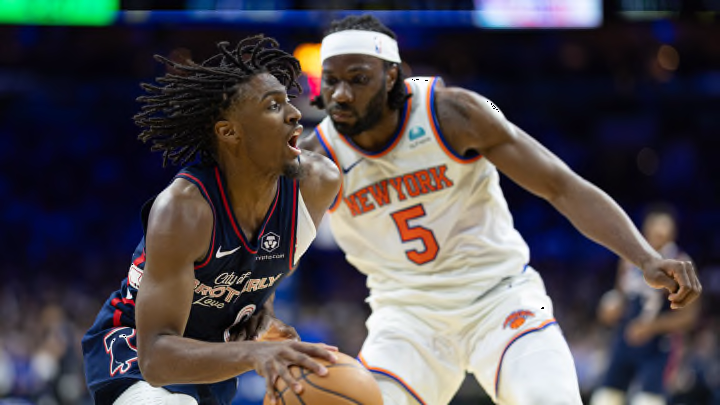
Here’s what I’m prepared say about the Sixers, sitting at 6-2, featuring a top-five offense and a top-five defense, leading the Atlantic Division and looking like a top-five overall team in the eyes of many:
This is a very good team, one worth rooting for if you like unselfish, disciplined team basketball on both ends of the floor. Philadelphia may well win the Atlantic Division, with Boston struggling to find itself (and probably content with the sixth seed if it comes to it) and the Knicks doing a yin-yang by the day. The Sixers are athletic, young, deep and long on the perimeter, and they will be an absolute pain for any opponent on any night.
But let’s go easy on putting them among the league’s elite, despite the hot start. Of the eight teams they’ve faced, only two — the Pacers and Trail Blazers, the latter of whom beat Philadelphia in the opener for both teams — are likely to make the postseason, and the Sixers have caught a bunch of schedule- and injury-related breaks. They have had the rest disadvantage in just one of those eight games, a visit to a Golden State team missing Monta Ellis. They caught the Pacers on Monday without Danny Granger and George Hill. They played the Suns early, when Marcin Gortat was still learning to deal with a broken thumb. They faced an already bad Detroit team with Rodney Stuckey and Ben Gordon in street clothes.On the flip side, the Sixers are one of the only teams to have faced the Hornets with Eric Gordon. But New Orleans was missing Trevor Ariza in that game, and while that’s not always a bad thing, it is when you’re giving 20 scoreless minutes to a shaky Al-Farouq Aminu.
I’m not saying Philadelphia is just so-so, or that this start is a complete fluke. This team is a joy to watch when it’s right, it should absolutely finish (on the low end) among the league’s top-10 defenses (it ranked seventh last season) and it has played beautiful offense. Let’s just hold off shoving the Sixers into the elite until they play some better teams, which starts Wednesday in New York and really kicks in with a three-games-in-four nights stretch next week against Denver, Atlanta and Miami.
The Sixers’ offense will determine whether this is a true playoff threat or a nice four-to-six seed capable of winning a playoff round before bowing out meekly against Miami or Chicago. Philadelphia ranked 17th in points per possession last season, and as I wrote in the lead-up to last season’s playoffs, the Sixers struggled to score against the league’s best defenses — the teams you must beat if you’re serious about playing in late May or beyond:
In 26 games against the league’s top dozen defensive teams, Philly has hit its average in points per possession only six times, and three of those games have come against the Pacers, according to Hoopdata. It’s been held to less than one point per possession — the rough average of the league’s worst offenses — in 15 of those 26 games.
That was last season, and they averaged just about one point per possession in a first-round loss to Miami. They have the league’s fourth-best offense this season, and if that holds up, the Sixers will have something. They are playing defense on a string, with everyone (usually) rotating correctly, helping at the right team and avoiding fouls. That should last.
In the meantime, let’s look at why the Sixers have the fourth-best offense after mostly struggling to score over the last few seasons. With apologies to Andre Iguodala and Jrue Holiday (progressing fast, if in fits and starts), the Sixers lack either of the two things that drive most elite offenses:
• A knockout perimeter scorer capable of breaking anyone down off the dribble and running a smooth pick-and-roll at all times.
• An elite post scorer who can draw double teams and fill the lane on the pick-and-roll.
When you lack those ingredients, you have to fill the void somehow, and the Sixers are doing it with constant motion, multiple pick-and-rolls on the same possession and solid off-ball cutting. Here’s one possession from the second quarter of Monday’s victory against the Pacers:
In about 10 seconds, the Sixers run two separate pick-and-rolls; send both Evan Turner and Iguodala from one side of the court to the other; and give everyone but Spencer Hawes a touch. The idea is to work the defense with constant motion until a hole opens up. It finally does when Turner, having gained some separation from Paul George, turns the corner on a pick-and-roll, gets into the lane, sucks in Iguodala’s man (Dahntay Jones) and dishes to Iggy for the drive. He misses, but this is great stuff.
Watch as Turner is making his baseline cut, and you’ll see why he gets separation from George: As Turner arrives under the basket, Hawes is rolling down the lane after the Sixers’ first pick-and-roll, and George pauses briefly to make sure Hawes is contained. While Hawes doesn’t touch the ball here, his presence is important; the play starts with Hawes setting a back screen for Turner, who cuts toward the rim. Hawes is an elite shooter for a big man, and so his defender can’t just leap off him to address Turner. It doesn’t produce much here, but the Sixers might get an easy bucket or two per game using Hawes this way.
Here’s another possession from the second quarter, just to hammer home the constant-motion theme:
That’s three pick-and-rolls leading to a Thaddeus Young jumper. Pay special attention to how backup center Nikola Vucevic flashes to the foul line as Young rolls:

The Sixers have four multiskilled big men in Young, Hawes, Elton Brand and Vucevic, and they use that versatility to create spacing. When one big rolls, the other will often flash to the perimeter, making himself available for an open look and pulling his defender away from the rim.
This is how you make up for the lack of a star perimeter scorer, especially when you have a pile of capable ball-handlers (Turner, Iguodala, Holiday and Lou Williams) and four versatile big men. Everyone has always wanted this Sixers team to run, but coach Doug Collins has chosen instead to play at an average pace but make sure the half-court game runs fast and crisp. It’s a well-run system that comes with caveats that must be tested against the league’s best defenses:
• It requires discipline and precision. Run this stuff at half-speed, and the offense fails. Waste a possession with a bad shot early in the shot clock or an ill-advised isolation play (looking at you, Lou Williams), and you’ve hurt your own efficiency.
• The best defenses — those in Miami and Chicago, especially — will be able to contain this for the first 15 to 20 seconds of the shot clock on a lot of possessions. It’s then that Philadelphia’s main weakness — the lack of a go-to scorer — will hurt. The Sixers will have to be on their game, on every possession, to score against those teams.
The calculus changes if Holiday develops into an elite pick-and-roll player or someone else (perhaps Young, still working on that off-the-dribble game) emerges as a top-level one-on-one scorer. But as things stand now, Philadelphia has to make the right reads and commit to running things this way in every half-court possession against the best defensive teams.
There are other questions about the Sixers, as there are with any team. Brand is off to a slow start. Holiday hasn’t yet shown another level of play consistently, though that should come. Williams will commit occasional sins on both ends. Opponents won’t shoot 26 percent from three-point range all season, though Philadelphia, ranked No. 1 in shooting percentage allowed on spot-up chances, was also among the league’s better teams in that category last season, per Synergy Sports.
And there’s Hawes, whose emergence as a scorer and more reliable defensive rebounder has opened up new lineup combinations for Collins. The Sixers were much better last season with Young as the power forward in small-ball lineups, but every one of those lineups — at least the ones that played regularly – featured the more rugged and polished Brand at center, not Hawes. But Young and Hawes have already played together a ton this season, and it’s important that this continue, given Brand’s age and slow start. For that to happen, Hawes must rebound at a career-best level, work hard on defense and find other ways to contribute offensively when his shot cools off.
Every team, save perhaps the Heat and Bulls, is dealing with questions like these. That Philadelphia is too should not obscure its wonderful start or its team-oriented style of play. But let’s see how it all holds up.

SI.com/NBA is part of the NBA.com Network. The NBA.com Network is part of Turner - SI Digital, part of the Turner Sports & Entertainment Digital Network.