Some players showing early progress


There has been plenty of bad news this week, between injuries to Zach Randolph, Manu Ginobili and Chuck Hayes; the firing of Paul Westphal; the booing at Madison Square Garden; and all the snark directed at slow-starting teams in New Jersey, Washington, Sacramento and elsewhere.
Let’s put the negative aside and focus on some individual players outperforming expectations and/or career norms. Can the following semi-surprises keep it up?

Nuggets big man Al Harrington is hitting a whopping 70 percent of his two-point shots. (Icon SMI)
• Al Harrington, F, Denver Nuggets
Harrington is shooting 70 percent on two-point shots and has emerged as an improbable Sixth Man of the Year candidate, though the award remains James Harden’s to lose. Unlike some of the other guys on this list, Harrington isn’t hitting an unsustainable number of long two-point jumpers. Of his 24 spot-up chances this season, all but a couple have been either threes or drives to the rim, according to Synergy Sports. He’s crashing the boards a bit harder, something he’ll have to do as a power forward (or even a center!) in coach George Karl’s small lineups.
The bad news: That two-point shooting percentage is going to come down, though Harrington figures to do better than his current 30 percent mark from deep. Also, he has been a total black hole this season, averaging less than a single assist per 36 minutes. On nights his shot doesn’t fall, Harrington is going to have to find other ways to contribute.• Andrea Bargnani, F-C, Toronto Raptors
The punchline is lighting it up, with a Player Efficiency Rating equal to that of Kevin Durant, a scorching shooting percentage on two-pointers, a small uptick in free throws and a better feel for help defense. Bargnani’s legendarily awful rebounding numbers are still pretty bad, but the Raptors are sixth overall in defensive rebounding rate, thanks to a gang rebounding mentality.
Bargnani won’t hit 79 percent of shots at the rim or 55 percent of his long two-pointers all season, but good things will happen if he keeps attacking, and new coach Dwane Casey has Bargnani cutting off the ball and curling around screens a bit more on offense. Keep up that kind of dynamism, and Bargnani should flourish as a scorer.
• Spencer Hawes, C, Philadelphia 76ers
The red flags are everywhere. Hawes, who leads the league in shooting percentage (67 percent!) and ranks 11th in PER, is shooting an insane 67 percent on long two-point jumpers and has attempted just six free throws all season. He is going to start missing some shots, and when that happens, Hawes doesn’t have the ability to make up for it by drawing free throws.
That said, there are real signs of development. He is a more active pick-and-roll threat — both as a pick-and-pop shooter and a roller in the lane — and he’s dishing assists at a career-best level. Versatility is always good, and Hawes and Elton Brand have the potential to form a dynamic scoring frontcourt — one in which they could flip-flop roles on pick-and-roll plays.
Hawes is also rebounding like a beast. Only seven guys with at least 50 minutes played have grabbed a higher percentage of defensive rebounds. If he keeps boarding like a real center, the Sixers can build a whole new set of small lineups around Hawes and Thaddeus Young.
• Marvin Williams, SF, Atlanta Hawks
The Hawks regularly benched Williams in crunch time in previous seasons, preferring a three-guard lineup in which Joe Johnson moved into Williams’ slot at small forward. This made some sense, because Atlanta was a so-so offensive team last season and Williams served mostly as a spot-up shooter who couldn’t really shoot, outside of a mini-burst of three-point shooting in 2008-09. But he’s a solid defender who can rebound, score in transition and add some athleticism on the wing.
As Rob Mahoney wrote for The New York Times earlier this week, Williams isn’t blowing anyone away this season, and his 2-of-10 performance in Atlanta’s miserable triple-overtime loss Thursday against Miami may portend some cold shooting to come. But he has shot the three-pointer well so far (46.7 percent), and more important, the Hawks are using him more on offense. He is making more plays off screens this season, according to Synergy Sports, and he has been aggressive going to the rim both on those plays and in spot-up situations. He has attempted about six free throws per 36 minutes, well above his career average.
Williams is never going to be a star or anything more than a fourth option on a good team. But if he’s an active fourth option, instead of a passive last resort, he’s a valuable role player.

Byron Mullens is hitting 62 percent of long twos this season. (David Liam Kyle/NBAE via Getty Images)
• Byron Mullens, C, Charlotte Bobcats
The Bobcats have happily served as the dumping ground for first-round picks Oklahoma City no longer need or want, and while D.J. White is shooting 60 percent as a tweener forward, Mullens might be the more surprising Thunder ex-pat. Mullens doesn’t have the quickest feet, meaning he’ll struggle defending the pick-and-roll and against quick post scorers, but he knows how to use his size around the rim, and he has a jump shot. He’s shooting 62 percent on long twos, according to Hoopdata. There will always be a place in the league for 7-footers who can space the floor.
Bad news: That might be all Mullens can do. He has struggled to finish at the rim or from the post, and he’s earned just 2.8 foul shots per 36 minutes despite attempting a whopping 17.3 field-goals per 36 minutes — the sort of shot frequency normally reserved for stars and chuckers. He has the rebounding numbers of a wing player, though the Bobcats actually lead the league in defensive rebounding, with solid rebounding from every position.
The league is littered with big guys who made a brief splash thanks to a semi-reliable jumper only to see their minutes cut back when it became clear they contributed little else. Will that happen to Mullens, too?
• Monta Ellis, G, Golden State Warriors
Ellis still shoots too much, especially from three-point range, and he might have to shoot more if Stephen Curry’s recurring right ankle sprains result in a lot of missed time for Ellis’ backcourt mate. But give Ellis this: He’s passing the ball a ton this season. Ellis is dishing 7.3 assists per 36 minutes, easily a career high, and he has assisted on 40 percent of Golden State’s baskets during his time on the court – an assist rate only seven players, all point guards, topped last season.
The Warriors’ offense ranks 26th in points per possession despite all this passing, and Ellis’ shot selection remains shaky. But Golden State’s perimeter shooters, especially Dorell Wright and Klay Thompson, have been unusually cold, and Ellis will help the team in the long run by distributing more — especially if he keeps his turnover rate as low as it is.
• Ricky Rubio, PG, Minnesota Timberwolves
A guy who could barely crack 40 percent in Europe (or 30 percent from three-point range) is shooting 53 percent in the NBA, and, perhaps most important, doesn’t look terrified to shoot jumpers. But let’s go easy: Rubio is shooting 36 percent on long twos — acceptable but slightly below average — and attempting just eight shots per 36 minutes, a low number, even for a pass-first point guard.
Still, he has shown a willingness to take and make mid-range pull-ups on the pick-and-roll and an ability to use the fake pass in the lane to create layups for himself. He has even made some spinning/leaning jumpers in the lane over smaller defenders.
None of this is spectacular, but it’s better than expected. And that’s good enough, considering his passing is as good as expected.
• Marshon Brooks, SG, New Jersey Nets
We knew Brooks would shoot too much, stop the ball and play selfishly at times, and the total lack of wing scoring in New Jersey has only made the light appear even greener. Brooks is one of just 12 players averaging more than 18 shot attempts per 36 minutes, and nearly 30 percent of the possessions he has finished with shots, turnovers or drawn fouls have come via isolation plays — a number nearly on par with Kobe Bryant last season, per Synergy Sports.
But you can’t really argue with the results. Brooks is shooting 46 percent (50 percent on those isolation plays), he has drawn an acceptable number of foul shots and he has turned the ball over just six times in seven games. On the one hand, that’s easy to do when you never pass, and Brooks’ assist numbers look a lot like Harrington’s. On the other hand, going one-on-one — and even facing occasional double teams — is a recipe for gaffes, and Brooks has avoided them.
Brooks won’t shoot well all the time, and the rookie is going to have games that will drive you crazy. There will be growing pains, but the early signs are good. Brooks appears to be a guy who can score at this level.

Unlike last season, Paul George plays a big role in Indiana's offense. (Ron Hoskins/NBAE via Getty Images)
• Paul George, SG, Indiana Pacers
Indiana’s blowout loss to the Heat was a reminder that growth comes slowly, in fits and starts, at the NBA level. George shot just 4-of-11, turned the ball over four times and looked unsure of himself as a ball-handler — a role the Pacers have asked him to play more this season.
But this kind of forced variety is good in the long run. Everyone knows by now that George has started on fire from three-point range (15-of-24 this season after shooting 29.7 percent last year), but the other stuff is just as important. Until and unless point guard Darren Collison jumps a level, it’s important for the Pacers to have options on the perimeter. George has looked decent running occasional pick-and-rolls, he’s getting to the line a bit more, dishing more assists and even emerging as a post-up option against smaller guards — a category that includes just about every guard.
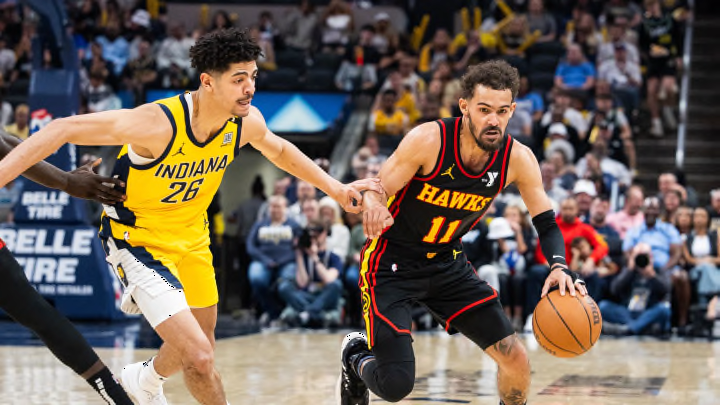
Last year, George was a defender searching for any role at all on offense. He has a role now, even if he and the team are still figuring out precisely what it is.
• Ryan Anderson, PF, Orlando Magic
Anderson’s rise to a borderline All-Star candidate is no surprise to anyone who has watched his per-minute numbers in Orlando. Those numbers haven’t really changed at all, but his minutes have jumped by nearly nine per game, and as a result, Anderson leads the league in three-pointers and is averaging nearly 20 points.
The same limitations are there: He doesn’t have the speed or length to be much more than an average defender, and his off-the-dribble game — mostly used on spot-up attempts when a defender is closing out like mad — is off and on, resulting in relatively few free throws for a player who grabs so many offensive rebounds.
But like anyone who has spent enough time with Stan Van Gundy, Anderson is a heady positional defender, and if he can stay on the court, he’s going to produce big numbers.
• Jarrett Jack, PG, New Orleans Hornets
Jack, like Monta Ellis, has an assist rate that is better than 40 percent for the first time in his career, though Jack’s overall statistical uptick is more the result of an increased burden than any major leap as a player. Someone has to play point guard in New Orleans, and Eric Gordon, who figures to assume a lot of ball-handling responsibilities, has missed four of the Hornets’ six games because of injury. The other perimeter players here are limited, inexperienced or both, and the Hornets are one of the worst offensive teams in the league.
Still, Jack deserves credit for maintaining his career shooting percentage and blowing by his career passing numbers in this role. He has never played more minutes or carried this kind of burden, and a player’s efficiency typically drops off when he has to do more than ever before. Jack is a pro.
• DeMar DeRozan, SG, Toronto Raptors
You know the numbers: DeRozan has made more threes already this season (10) than he made combined in his first two seasons (nine). That is crucial for a team that needs floor spacing on the wing — and for DeRozan to develop into a valuable franchise piece.
Something interesting to watch: Casey has turned DeRozan into less of an offensive centerpiece and more of a spot-up guy — one capable of working off the dribble as well as launching outside shots. About 12 percent of the possessions DeRozan used last season came via isolation plays, and another 15 percent saw him run the pick-and-roll. Those numbers are down this season to 5.7 percent and 8.5 percent, respectively, and nearly all of those possessions have shifted to spot-up tries, per Synergy.
The shift has worked, but it also reflects how much room for improvement there is in DeRozan’s passing and decision-making with the ball. That’s the next step. One thing at a time.

SI.com/NBA is part of the NBA.com Network. The NBA.com Network is part of Turner - SI Digital, part of the Turner Sports & Entertainment Digital Network.