Why do players care about a hard cap?


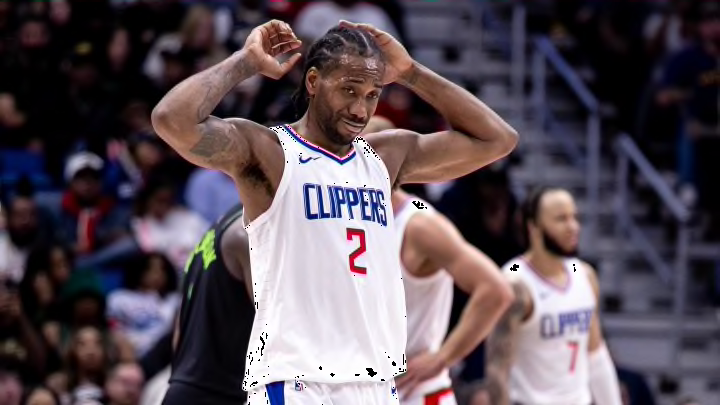
Derek Fisher and the players' union are worried mostly about the combination of a hard cap and a lower percentage of basketball-related revenues. (AP)
Some readers have emailed me the same question, which means there is enough confusion out there to address it in some detail: Why are players and their representatives so set against a team-by-team hard salary cap?
Under the old collective bargaining agreement, players were guaranteed 57 percent of all basketball-related revenues. This created a funky system in which a player’s real salary was almost always either bigger or smaller than his listed salary. Think about it like this: If you took all player salaries and benefits, added them up and found they came to less than 57 percent of total league revenues, the league would have to write each player a check until the players, collectively, saw their total salaries rise to that 57 percent mark. That scenario happened after last season, when revenue jumped more than expected, and the league paid each player (via an escrow fund) an amount linked to their listed salary.
We don’t know what the new CBA will look like, but all parties agree it will likely center on a percentage split of basketball-related revenues, just as the old system did. Negotiations so far have focused on how to define what goes into that revenue pool and then how to divide it. In other words: Players as a whole will be guaranteed a percentage of league revenue. This fact confuses readers who don’t understand why, when guaranteed that set amount, players care so much about what each team can spend. A hard cap might depress a player’s listed salary, but if revenue jumps, that player’s salary is going to jump with it, right? What’s the big deal about a hard team-by-team cap, then?
I had my own thoughts, but I decided to turn this one over to a few experts — labor lawyers, agents and attorneys involved in the negotiations. A sampling of their answers, most of which touch on the impact this would have on average veteran players — a key recurring theme:

Jeffrey Kessler, Dewey & LeBoeuf partner, lead outside counsel to players’ union: “If you have an individual team hard cap, you are going to be desperate to maintain flexibility and to remove and replace players. And that means all but the stars would likely lose their guaranteed contracts. If you have a hard cap for every team, and you’re going to pay the stars of the game fairly, there isn’t going to be enough money left over for the other players. Every NBA player understands this. Big time.”
Mark Bartelstein, player agent: “A hard cap at the team level obviously takes away a tremendous amount of flexibility and movement. Everybody in the world wants to choose where they work. Maybe a player wants to play in a certain city or for a particular coach. If you make the system more restrictive with a hard salary cap, teams that are bumping up against that cap can’t go beyond it and pursue free agents. And suddenly there is no such thing as a free agent.”
Andrew Zimbalist, professor, sports economist: “The players believe that when you have a soft-cap system with exceptions that allow teams to go over the cap, teams can pay more money to players, such as players who have Larry Bird rights. And what that does is it sets a benchmark for the market value of those players. That benchmark is important for making the argument later on that a particular player deserves more money. You want to be able to go to the bargaining table and say, ‘This player got X, I deserve X plus 3 percent.’ This is what happens when a free market is allowed to operate.”
(Zimbalist added this: “The bigger struggle is the percentage [of basketball-related income] rather than the hard versus soft cap.”)
Gabe Feldman, law professor, labor/sports law expert: “If the players were allowed to keep their current 57 percent but had to accept a hard cap, then I’m not sure the players would have as much of an issue. They are worried mostly about the combination of a hard cap and a lower percentage. But just taking the hard cap on its own, there would be less money to go around for the veteran fringe guys who are often overpaid at this point. The stars will get their money — it’s never the superstars who are hurt. But if you institute a strict payroll cap, there will be less money to go around.”
I could go on, but you get the point, and the question is sort of moot anyway, since owners want to cut the players’ share of league revenues to a level the union says it cannot accept. But you can see in these responses — from stake-holders and experts, alike — how concerned the union is for the rank-and-file veterans, and how different that group of players is from both superstars and guys on rookie deals. (Note: Mike Wise’s bang-up piece today in the Washington Post gets at this same issue in discussing “dead” contracts tied to underperforming veterans.)
It’s easy to say the players will earn what they earn, whether the cap is soft or hard, as long as total player salaries are tied to the league’s overall revenue. That hard cap scenario might be scary for those run-of-the-mill veterans, though. Imagine each team has a hard cap of $50 million, and they reserve $30 million of that for two superstars. That leaves $20 million for at least 11 players. Suddenly there are fewer guys with listed salaries in the $4 million-$6 million range and many more earning $1 million to $2 million. Even in a system in which players might end up earning more than their listed salary, it’s not hard to imagine them taking a big overall hit if the end-of-year pay bump they get is based upon a salary floor that is suddenly much lower.
The broader choice issues are real, too — the notion that teams might be less willing to fling guaranteed money around to non-stars, and the possibility that, at least as teams get used to the new system, fewer franchises will be true free agency players every summer.
There might be some fear-mongering going on here, but this at least gets at why the percentage isn’t everything, even if it’s the biggest thing.

SI.com/NBA is part of the NBA.com Network. The NBA.com Network is part of Turner - SI Digital, part of the Turner Sports & Entertainment Digital Network.