Key role players in West keep options open

Decrease fontDecrease font
Enlarge fontEnlarge font

J.J. Barea is an unrestricted free agent while Shannon Brown has a player option worth $2.4 million for next season. (Icon SMI)

There will be bigger free-agent stories, even in the next 48 hours, when we’ll learn whether the Trail Blazers will extend a qualifying offer to Greg Oden and if the Nuggets manage to hammer out a new deal for Nene. But it’s worth noting that two role players on two of the best teams in the league have made it clear they will look around, loyalty be damned.
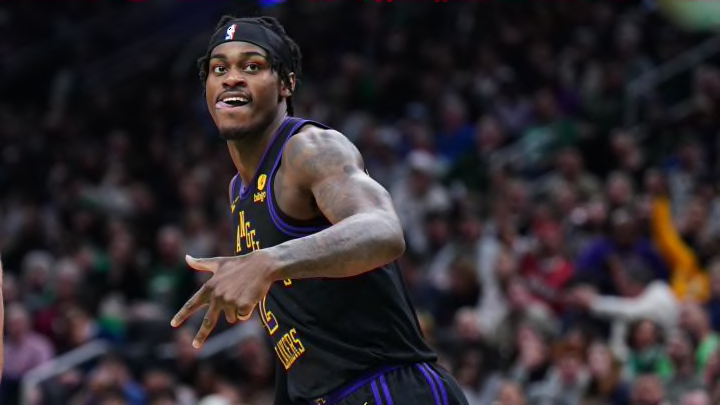
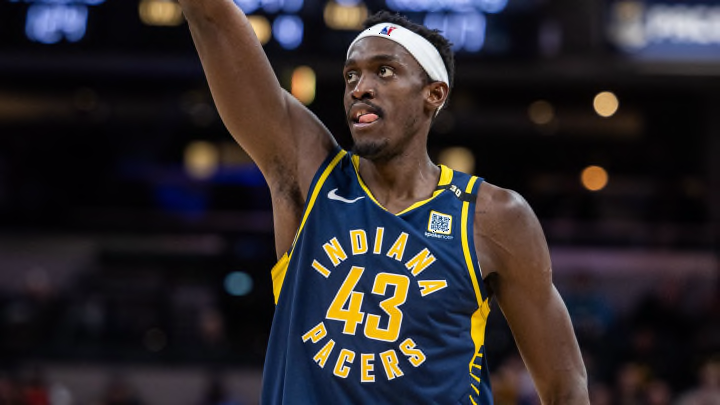
J.J. Barea and Shannon Brown aren’t stars and they will probably never even be starters on a good team, but they are important players, especially because their current teams may not be able to find guys who can replace the skills they bring.

Let’s start with Barea. It’s possible no player has ever increased his profile as much by shooting 42 percent in the postseason, as Barea did in helping the Mavericks win the title. He destroyed the Lakers – who were so shockingly clueless on defense – with his pick-and-roll game, and coach Rick Carlisle’s move to insert Barea into the starting lineup in Game 4 of the Finals was perhaps the turning point of that series. The basketball world was focused on the Heat-Mavs series, which means some team may gamble and overpay Barea just as the league institutes a new collective bargaining agreement.

That’s not a shot at Barea, who has said he’d like to play for the Heat or Knicks (who wouldn’t?) if the Mavericks don’t pony up enough to get him back. He’s a nice player, but you have to be very careful committing even league-average money to him. He has never been more than an average three-point shooter, and though he has thrived as a pick-and-roll killer, it’s impossible to know how much of that ability is tied to his partnership with Dirk Nowitzki. The big fella serves as Barea’s most common screener on pick-and-rolls, and opponents’ fear of Nowitzki’s jumper often gives Barea huge openings into the lane. The big men guarding Nowitzki are terrified to jump out on Barea and leave Dirk open for a possible pick-and-pop jumper, and on those occasions, Barea can turn the corner more easily than most point guards can dream of doing. This action is especially potent when the Mavericks can surround Dirk and Barea with a capable release valve at center (Tyson Chandler) and two three-point shooters.

Barea ranked as the 14th-most-efficient pick-and-roll player in the league when he finished those plays (with either a shot, turnover or drawn foul), according to Synergy Sports, and that’s obviously a great mark. Barea is good enough to function outside this Dallas context, but it’s reasonable to assume he might not operate quite as well on offense, and if that’s the case, the line between asset and liability gets blurrier. Barea, generously listed at 6 feet, is always going to be a bit of a weak link on defense. Even during their title run, the Mavericks allowed nearly 14 more points per 100 possessions with Barea on the court. That number is an outlier, pushed to the extreme by a small sample size, but Barea has never been a plus defender and his individual numbers on Synergy show he struggles in nearly every one-on-one situation.

But here’s the rub: Dallas may not have anyone ready to duplicate Barea’s skills. On a team of aging guards who love jump shots, Barea is really the only guy capable of attacking the rim and getting into the paint consistently. Even in limited backup minutes, Barea finished one-third of the Mavs’ pick-and-roll plays in the postseason and one-quarter of them in the regular season – huge numbers we’d normally associate with a starter. Maybe Rodrigue Beaubois or Dominique Jones could fill that role, but Beaubois just had another surgery on the foot he broke last summer, and Jones barely played in his rookie season.

To make matters even more complicated, after acquiring Rudy Fernandez on draft night, the Mavs have nine players guaranteed money next season — not including the team’s other free agents (Chandler, Caron Butler, Peja Stojakovic, DeShawn Stevenson and Brian Cardinal) or Ian Mahinmi, who’s currently under a non-guaranteed deal for next season.

In other words: There aren’t all that many spots left here, and even if the Mavs re-sign Chandler, they need to think about finding another reliable big man capable of spelling Nowitzki.

And then there’s Brown, who has indicated he may opt out his $2.4 million deal for next season in Los Angeles. Brown shot 28 percent from three-point range in the playoffs after hitting just 26 percent from deep once the calendar flipped to 2011. His hot early-season shooting proved a fluke, and if he’s not hitting shots it’s fair to ask what exactly he brings to the Lakers. He’s a capable defender, and his athleticism is helpful on an aging team — especially in transition. But he hasn’t developed a reliable off-the-dribble game or shown that he’s ready to assume a larger offensive load, either on bench-heavy units or when he plays with a bunch of starters.

Still, the Lakers, like the Mavs with Barea, might worry they don’t have anyone who can fill Brown’s shoes. Their point guards are either old or unproductive (or both, in Derek Fisher’s case), and their other possible bench options beyond Lamar Odom — Luke Walton and Matt Barnes — don’t bring Brown’s quickness or the ability to consistently defend shooting guards. Kobe Bryant has to rest sometime, right?

The Lakers addressed all of this by drafting Darius Morris and Andrew Goudelock last week, but second-rounders rarely amount to much and even fewer contribute immediately on veteran-heavy contenders. If Brown does opt out of his deal, the Lakers might have a tough decision on their hands. Even still, they are so capped-out already that they might be willing to overpay Brown on a short-term deal just to be safe.

  • Published On 11:16am, Jun 29, 2011