Tressel scandal revives age limit debate

Decrease fontDecrease font
Enlarge fontEnlarge font

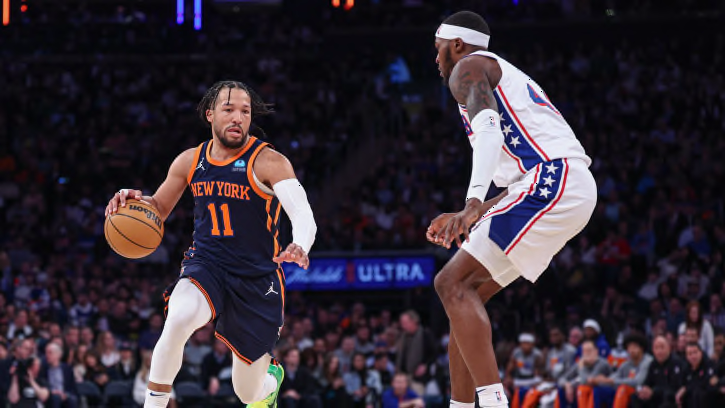
Brandon Jennings became the first player to skip college and play pro ball in Europe. (Ron Hoskins/NBAE via Getty Images)
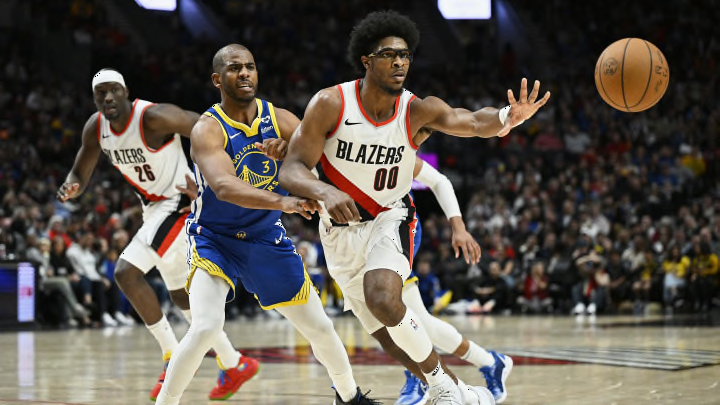
As I devoured Sports Illustrated’s fantastic reporting on Jim Tressel and the avalanche of stories covering the football coach’s resignation from Ohio State, I kept thinking back to the concept of age limits in the NBA and other leagues, even though the age limit issue is not precisely implicated in this case.
Amid all the alleged details of no-show jobs, tattoos-for-memorabilia, small cash gifts and cars (oh so many cars), I asked myself two questions:

1) Why do we care about this?

2) Why are these players in college?

Let me be clear: The huge majority of scholarship athletes are in college to get an education, play sports on the side and learn a whole bunch of stuff. Even most football players at big-time schools aren’t headed for the NFL, and once they realize that, their goal should shift to getting the most out of their free education. When asking why players are in college and not the pros, it’s important to remember we’re talking about the tiniest subset of players.
As for the first question, I suppose we care because rules are rules, and they carry punishments if broken. And perhaps because players essentially exchanging their athletic skills for cash feels unseemly. (As a side note, it’s useful to remember that the biggest sin committed here appears to have been Tressel’s attempt to cover up the initial sins.)

But in the cases of the best players (like Buckeyes quarterback Terrelle Pryor, perhaps), the NCAA rules would never apply if those players who wanted to were allowed to go directly into professional leagues from high school. Many of those players — perhaps most of them — would choose to go to college. It’s fun, and it must be even more fun to be royalty for a year or two and play ball for a storied program led by a coach who prepares you for the next level.

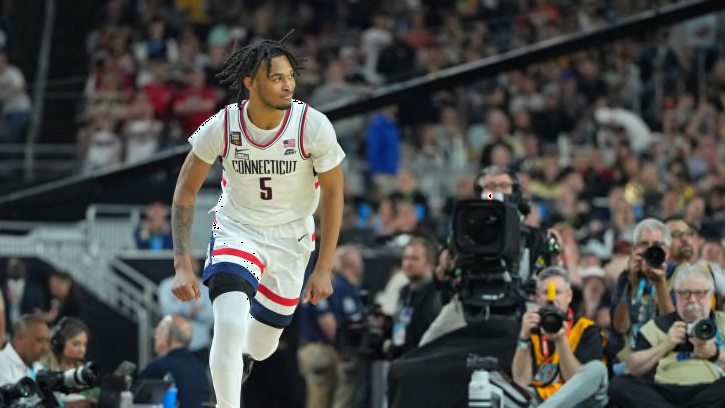
Still, it seems silly to force this pseudo-amateurism on players who don’t want it. Of course, the NBA’s age limit doesn’t do that, at least in theory. The rule prevents players from becoming eligible to enter the NBA until they are 19 or their high school class is at least one year removed from graduation. Players don’t have to go to college; they can play in the D-League or sign a one-year contract for an international team, and several pretty high-profile guys have gone those routes. But most of them do attend college for at least a year, and their attendance places them in a world full of temptations that lead to scandals. It’s up to you to decide whether those scandals are truly scandalous or reflect a broken system with strange rules.

Back to the age limit: The league has made noise about upping it to 20, a move the players’ union has said it opposes, even though the union does not represent players outside the league. Some members of that union — marginal veterans — have at least a slight interest in keeping the best 18-year-olds out of the league, right? Sources close to both sides have said the age limit is a minor issue amid the collective bargaining talks, so it’s unclear exactly what the rule will look like a year from now.

Alan Milstein is a lawyer who represented Maurice Clarett in the Ohio State running back’s suit against the NFL’s age limit, and he has said before that he is looking around for the right player to challenge the NBA’s rule. Milstein told me Tuesday that any move to increase the age limit will accelerate his fight against it.

“If they add another year, I have absolutely no doubt that somebody will be ready to challenge it,” Milstein said. “It will certainly make the pool of potential litigants bigger.”

Proponents of the age limit tend to talk about the importance of even one year of college and the notion that 18-year-olds are not ready for the NBA lifestyle. Teenagers need a bit more maturity before getting thrust into that world, these folks say.

A few things:

• Michael McCann, a professor at Vermont Law School, sports law specialist and SI.com contributor, published research showing that guys who entered the league straight from high school actually outplayed (slightly) the NBA’s overall player pool. His further research showed that the high school guys (by some measures) also got into less off-court trouble through their careers.

There are exceptions of course, and one could argue that players drafted out of high school play so well because they are the very best among their graduating class. But isn’t the point of the draft to give the very best players a chance to make money?

• The NBA’s support of an age limit is not based on ethics, morals or the value of an education. It is based largely on something more practical: the ability to scout players in a more convenient and cost-effective way. Commissioner David Stern could not be clearer on this (via The New York Times):

“This is not about the NCAA, this is not an enforcement of some social program,” Stern said. “This is a business decision by the NBA, which is: We like to see our players in competition after high school.”

In other words: It’s much easier to get an accurate read on players when they play on television a lot, and when those televised games come against other very good players. Most NBA front offices are actually pretty small; they’d have to beef things up in order to scout high school players all over the world.

Again: This issue is not explicitly linked to the Tressel case. That matter involves a different sport and players of all levels. Plus, there’s the safety factor attached to the NFL’s age limit, something Milstein has conceded in the past; most high school football prospects simply aren’t big enough or strong enough to hold their own against 300-pounders in the NFL. But whenever I read about a college sports mini-scandal — and there are a ton — I wonder: Why are the best guys even there?

  • Published On 2:29pm, May 31, 2011