Draft lottery makes Clippers target of ridicule


Taking on Baron Davis' big contract helped the Cavaliers land the No. 1 pick in the draft. (AP)
While Cleveland celebrates its good fortune in Tuesday’s draft lottery, the Clippers are coming to terms with the fact that they just handed the Cavaliers the No. 1 pick.
In February, Los Angeles traded an unprotected first-round selection in the June draft, along with Baron Davis, to Cleveland for Mo Williams. Giving up the draft pick was the price the Clippers paid to dump Davis’ hefty contract. The Clippers understood then that there was a small chance it would turn into the top pick. (Cleveland made good on its 2.8 percent chance of winning the top pick with the Clippers’ first-rounder.)
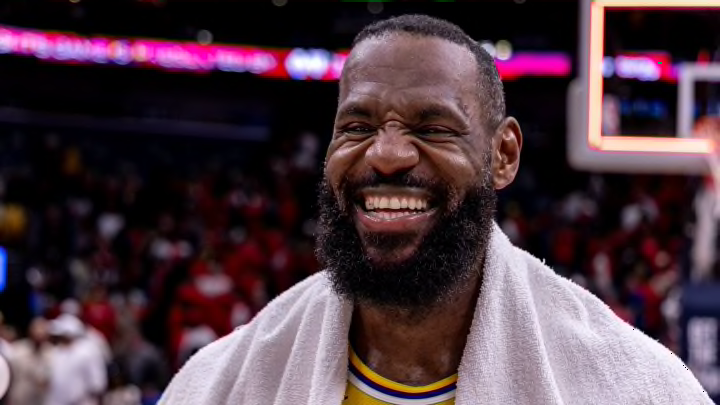
So now we all mock the Clippers for this allegedly disastrous trade. But here’s the thing: The merits of the trade are no different today than they were when it happened. Reaction was pretty split — I gave the deal a tepid thumbs up for both teams – and if you praised the deal then, you’re in no position to bash it now. Doing so would be sort of like criticizing a team’s defense when it “allows” LeBron James to hit a contested three-pointer toward the end of the shot clock; the result does not change the fact that the process leading to it was defensible.
If you believe that a franchise on the rise should never trade a lottery pick, especially an unprotected one, that’s fine. Lots of folks ripped the Clippers for surrendering an unprotected first-rounder in exchange for cap savings. (Note: The Clippers, in theory, could have asked for protections on the pick, but since they had already traded a protected 2012 first-rounder to the Thunder for Eric Bledsoe, the rule against dealing consecutive first-round picks would have made protecting this one difficult. Larry Coon explains here.)
John Krolik articulates that position nicely in a celebratory post at Cavs the Blog:
The point isn’t that the Cavs’ 2.9% chance ended up coming through – it’s that the Clippers, a team in no position to make a legitimate playoff run in the next season or two, made a move that took away from their upside for a short-term gain.
Teams in the Cavs and Clippers’ position should NEVER, EVER DO THAT. The move blew up in the Clippers’ face in the lottery in reality – maybe it would have ended up blowing up if the pick they traded turned into the 8th pick, and Jan Vesely ended up becoming an absolute monster.
All of this is true, but it’s very difficult to judge this trade in any final sense until we see two things: 1) if the Clippers can land a major free agent in the next two years; and 2) how the collective bargaining agreement shakes out.
The Clippers saved $11.65 million in salary over the next two seasons by swapping Davis for Williams. Their committed salary for 2012-13 is $24.4 million, according to ShamSports; it would be $30.65 million had they kept Davis. That difference could be crucial in netting Dwight Howard or Chris Paul as free agents in 2012, or in pulling off some other transactions down the road. The Clippers have to re-sign DeAndre Jordan this summer and Eric Gordon next summer. Those deals will cost money on top of that $24.4 million figure — how much is impossible to tell now – and having $6.25 million less in salary on the books for 2012-13 could end up being the difference between extending the contracts of those two players and then offering a maximum deal or something less appealing to Howard or Paul.
The savings also could end up being irrelevant if the Clippers’ chances are compromised by such potential factors as a lower-than-expected cap; a new CBA that gives incumbent teams (like Howard’s Magic or Paul’s Hornets) an insurmountable advantage in keeping their own free agents; a liberal amnesty provision that helps more teams carve out huge chunks of cap room; or a league ban on sign-and-trade transactions.
The Clippers bet on that cap room knowing that it carried the big risk of collective bargaining uncertainties and the smaller risk that their pick would become golden. Of course, the latter is exactly what happened Tuesday night, and the likelihood that the Clippers come up losers in this deal just went way up.
But they’re not losers quite yet, and even if they end up that way, that result doesn’t taint the reasoning behind the deal.

SI.com/NBA is part of the NBA.com Network. The NBA.com Network is part of Turner - SI Digital, part of the Turner Sports & Entertainment Digital Network.