Who would be waived with amnesty clause?

Decrease fontDecrease font
Enlarge fontEnlarge font

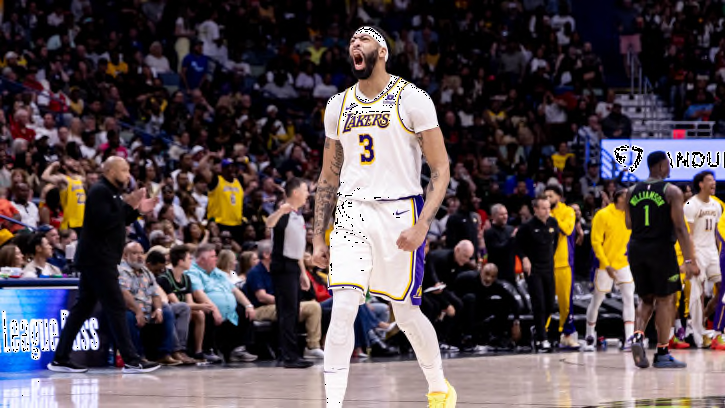
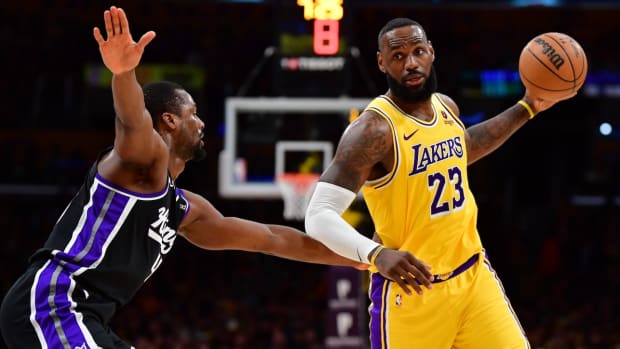
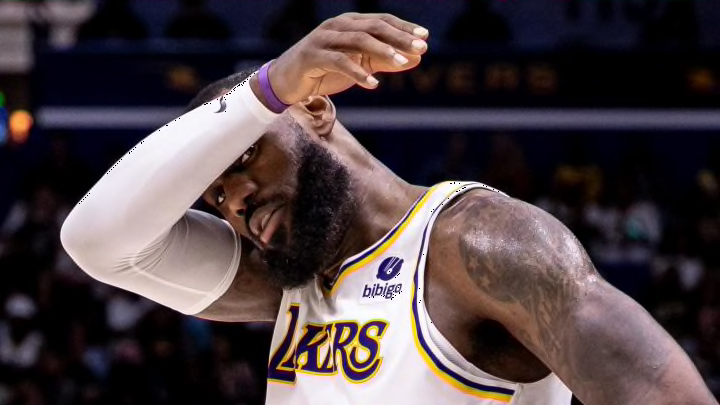
Steve Blake would probably be the Lakers' best amnesty candidate, since he's replaceable and is owed $12 million combined over the next three seasons. (Matt A. Brown/Icon SMI)

Details of the league’s proposal for a new collective bargaining agreement are dribbling out. Most of them are pretty much as expected — a hard cap, a ban on fully guaranteed salaries, a watered-down version of the NFL’s “franchise tag” designation that sounds very much like Bird Rights, and a one-time-only amnesty provision.

How the amnesty provision would work remains unclear, but we can make some educated guesses based on precedent and conversations with experts and sources close to the negotiations. The league offered teams an amnesty provision after the 2005 collective bargaining talks. That provision allowed teams to waive one player, with three major caveats:

1) The team still had to pay that player’s full salary.

2) The salary still counted against the team’s cap number.
3) Teams could not waive a player and then re-sign that same player until the expiration date of his original contract.

So what was the point? As Larry Coon explains here, the amnesty provision applied to the league’s luxury tax. The salary attached to the waived player would not count against the luxury tax, meaning a team set to come in over the tax — or anticipating that it might do so in the future — could cut its tax bill by releasing a player of its choice.

The amnesty thus offered little help to teams under the salary cap or barely over it (but under the tax line). They could waive a player if they didn’t like him or wanted to create a roster spot, but doing so would not save them any money or lower their cap figure.

The league’s initial amnesty proposal this time appears to offer broader relief, since the overall proposal would revamp the collective bargaining landscape so dramatically. If you’re going to institute a $45 million hard cap, you need to provide relief for teams that beefed up their current payrolls well beyond that level under an old system that may no longer apply. And that relief, in the league’s view, probably has to extend beyond the proposed two-year phase-in period. That’s why this amnesty provision would probably apply, for now at least, to a team’s cap number regardless of whether its current payroll would exceed any luxury-tax barrier.
With that in mind, it’s fun to think about which players teams might shed under this amnesty provision. (All salary data via ShamSports.)
Atlanta Hawks: As I wrote a few days ago, Atlanta fans might rejoice at the notion of the team amnesty-ing its way out of the $107 million it will owe Joe Johnson over the next five seasons. But that’s unrealistic because the amnesty proposal would still require teams to pay the waived player. Johnson might be overpaid, but he’s still productive, and a team with a recent history of dodging the luxury tax is not going to shell out $107 million just to get Johnson off its cap figure. That leaves Marvin Williams, who is set to make about $25 million over the next three seasons.

Boston Celtics: There’s no real crisis here because two of the big deals expire after next season: Kevin Garnett and Ray Allen. The team has only Paul Pierce, Rajon Rondo and Avery Bradley under contract beyond 2011-12. Losing Jermaine O’Neal’s $6.2 million salary for next season could help in the sense that Boston’s ownership might feel a bit more comfortable adding salary (via trade or the mid-level exception, if it exists) with the veteran big man off the books.

Charlotte Bobcats: Goodbye, DeSagana Diop. The veteran center is owed $14.3 million over the next two seasons, assuming he exercises his player option in 2012-13 (duh).

Chicago Bulls: Pass. There is no need here. The angriest Chicago fans might suggest dumping Carlos Boozer’s huge contract and using the suddenly free cap space (if the amnesty works this way) to sign, say, Dwight Howard, but that dreamy cap space might not amount to much under the new CBA and a reduced cap figure.

Cleveland Cavaliers: Talk of veteran leadership and runs at the eighth seed are nice, but there’s really no need for the Cavs to reserve $14.8 million of cap space for Baron Davis in 2012-13.

Dallas Mavericks: Mark Cuban is perhaps the league’s biggest spender, so he might not mind clearing the $41.6 million he owes Brendan Haywood in guaranteed money through 2014-15 even if he has to pay the backup center in full to do it. Haywood has played some solid minutes in the postseason, but that’s too much money for him, especially if Dallas manages to re-sign Tyson Chandler.

Denver Nuggets: Al Harrington and Chris Andersen can fight over Denver’s amnesty pick. The gap in salary between them isn’t as big as it might seem because the final two seasons of Harrington’s deal are only 50 percent guaranteed as things stand now.

Detroit Pistons: Wow, could this team use some salary-cap amnesty. It’s tempting to slash Ben Gordon’s deal, which is worth $37.2 million over the next three seasons, but he is probably in that “Joe Johnson sweet spot” where it’s too early to dump him if doing so means paying him in full anyway. The same may be true of Charlie Villanueva. That would leave the aging Richard Hamilton, who is set to be paid $21.5 million in guaranteed money over the next two seasons.

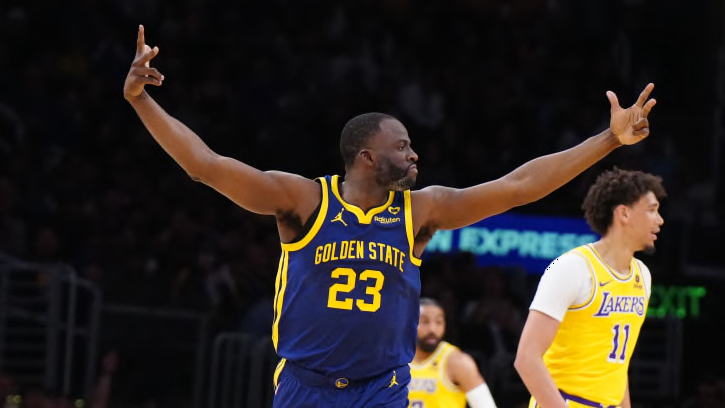
Golden State Warriors: Andris Biedrins is on the books for $9 million in each of the next three seasons. While it’s tough to swallow the idea of paying a guy $27 million to go away, the Warriors could have a pretty clean cap sheet if Biedrins no longer counts against their cap figure. The big fella is only 25, but he showed no signs this year that he might return to his peak form of 2008-09. He’s the only realistic amnesty candidate here.

Houston Rockets: Another team that has very little need for the amnesty provision, considering how many of its players have cheap rookie deals that carry team options. Brad Miller might be the best candidate. He’s 35, and his minutes fell of a cliff this year amid various health issues. The Rockets owe him $4.8 million next season and $848,000 in guaranteed money for 2012-13.

Indiana Pacers: James Posey is the no-brainer choice. Eliminating his $7.6 million salary for next season would open up even more cap room for the Pacers. Danny Granger is overpaid, but there’s no way the Pacers dump him after all the good will they built up with their feisty playoff performance against the Bulls.

Los Angeles Clippers: An intriguing battle between Mo Williams ($17 million over the next two seasons, both at his option) and Chris Kaman ($12.7 million next season). Williams is probably the better choice, even if the Clippers could use him for another season to help Eric Bledsoe grow into the point guard role. Kaman could be decent trade bait on an expiring deal.

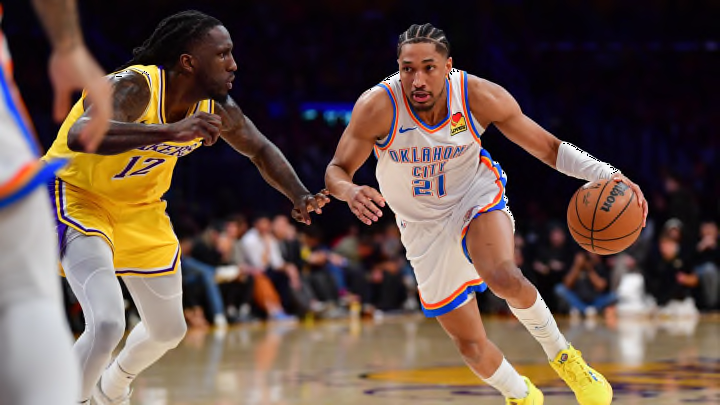
Los Angeles Lakers: Take your pick between Ron Artest, Steve Blake, Luke Walton and Derek Fisher. Blake is probably the best candidate because he’s replaceable and is owed $12 million combined over the next three seasons — a hair more than Walton and a big chunk more than Fisher, whose deal expires a year earlier. Artest will make more than all of them — he’s set to receive $7.7 million in 2013-14, unless he terminates his deal early — but he’d be harder to replace.

Memphis Grizzlies: Pass. O.J. Mayo might be the only realistic candidate here, but his rookie deal expires after next season, and there’s little to suggest that the Grizzlies are ready to pay someone $5.6 million to go away — even if they do have to re-sign Marc Gasol in the offseason. Mayo played well for the Grizzlies after they nearly traded him in February, and was crucial during their playoff run.

Miami Heat: Mike Miller has a player option for $6.6 million in 2015-16. Ouch. The Heat are probably going to struggle for cap room under the new system no matter what because they have so much money committed to three guys, so parting with Miller might make little difference.

Milwaukee Bucks: The Bucks are right there with the Pistons and Lakers in the race for best amnesty candidate. Take your pick between Corey Maggette (about $21 million over the next two seasons), Drew Gooden ($26.3 million guaranteed over the next four seasons) and John Salmons ($25.17 million guaranteed over the same stretch). The Bucks would have to pay these salaries regardless, but dumping Gooden or Salmons could give them plenty of future cap room to throw at free agents … who will never sign there. (Sorry.)

Minnesota Timberwolves: Darko Milicic might look less like “manna from heaven” if the Wolves had the chance to cut the $11.8 million salary he’s guaranteed. Point guard Luke Ridnour is owed about the same amount, and with Ricky Rubio still in Minnesota’s sights, he’d make more sense as an amnesty cut.

New Jersey Nets: The Nets owe Travis Outlaw $28 million over the next four seasons. It might hurt to pay the swingman that much for nothing, but he’s the only great candidate here, and that extra $7 million in cap space might become more important in a world with a lower salary cap.

New Orleans Hornets: Things get interesting here. Emeka Okafor will earn $14.5 million in 2013-14 unless he terminates his deal a year early. That’s a lot of potential cap space tied up in a decent-but-not-great center — especially since 2013-14 would be the first season after the two-year phase-in period for the hard cap under the league’s current proposal. On the other hand, it’s tough to imagine a franchise currently owned by the league paying Okafor such a huge sum to go away.

That leaves Jarrett Jack, whose friendship with Chris Paul could come into play, even though he’s to be paid $10.4 million over the next two seasons. That’s not bad, really.

What about Trevor Ariza? He’s a very nice defensive player, but he had a miserable shooting season, and he’s miscast as a threatening wing scorer. He’s due nearly $22 million over the next three seasons, but he’s also New Orleans’ only real athlete on the wing, and Paul has said he enjoyed playing with Ariza this season. Could the Hornets really afford to pass?

New York Knicks: They just picked up Chauncey Billups’ full $14.2 million deal for next season, making him both their starting point guard and an expiring contract. But they could open up some offseason cap space by clearing him from the books. Of course, the Knicks might not really care about having cap space now because any long-term signing could jeopardize their pursuit of Paul and Dwight Howard.

That would leave Ronny Turiaf’s $4.4 million deal for next season — another expiring deal — as the only other option. That could be useful trade filler, so perhaps New York passes.

Oklahoma City Thunder: With James Harden getting better every day, the Thunder probably don’t need to pay Thabo Sefolosha $11.5 million over the next three seasons — especially since the Russell Westbrook extension bill will come due soon. That said, Sefolosha is popular among his teammates, and the Thunder could also clear $4.5 million off next season’s cap figure by dumping Nate Robinson. But $4.5 million expiring contracts can always come in hand. Another pass?

Orlando Magic: It might hurt, but if given the chance, you get out of Gilbert Arenas’ deal ($62.4 million over the next three years).

Philadelphia 76ers: It’s tempting to suggest Elton Brand, who won’t be worth $18.2 million in 2012-13, but his deal expires after that season and he was productive this season. Without Brand around to grab boards and swing to center, there is almost no NBA-level size here. That leaves Andres Nocioni, who is owed $6.7 million next season. Lose him, and the Sixers could have a decent chunk of cap room, depending (as always) on how the new CBA shakes out.

Phoenix Suns: The Josh Childress deal, which carries a player option worth $7.3 million in 2014-15, looks like a pretty big stretch after he struggled to even crack the rotation in his first year with the Suns. He’s also about to turn 28, meaning we can’t really use the word “potential” with Childress anymore. Still, Childress has been productive in the NBA before, and the Suns will need wing players if Grant Hill and Vince Carter are both gone next season. And paying Childress the remaining $27 million on his contract just to clear cap space is a pricey exchange.

That leaves Hakim Warrick ($8.5 million over the next two seasons, plus a $4.3 million team option for the next one) and Channing Frye ($24.8 million over the next four seasons). Warrick vacillated between productive and out of the rotation, while Frye surged in the second half of the season and played to his contract.

Portland Trail Blazers: If it’s too early to pay Brandon Roy a small fortune for nothing, there might not be a viable candidate here. The team got solid production from Gerald Wallace ($10.5 million next season, a player option for the same in 2012-13), and Marcus Camby’s deal expires after next season. Beyond that, it’s Wesley Matthews, Andre Miller’s nonguaranteed (and expiring) contract and a bunch of rookie deals.

Sacramento Kings: No team has so little future guaranteed salary on its books, and you have probably heard the Kings’ current ownership isn’t exactly in a place to pay someone millions to play on another team. In a different universe, the Kings might be happy to use the amnesty provision on either Beno Udrih or Francisco Garcia.

San Antonio Spurs: Richard Jefferson restructured his contract to make it more palatable, and yet he’s still somehow grossly overpaid. Jefferson is due $30.5 million over the next three seasons (the last at his option), and the Spurs could have huge piles of cap room if they rid themselves of his cap figure. That said, when you think of the savvy Spurs, you don’t imagine the sort of franchise that would pay $30.5 million for exactly zero on-court production; using the amnesty provision on Jefferson might be too hard to swallow.

Beyond Jefferson, there are only untouchable stars, cheap role players and young building blocks, with Matt Bonner (about $8 million guaranteed over the next three seasons) the only player who might not fit cleanly in any of those categories.

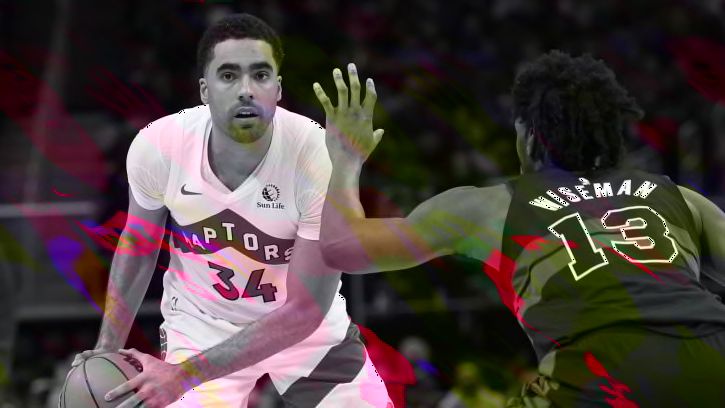
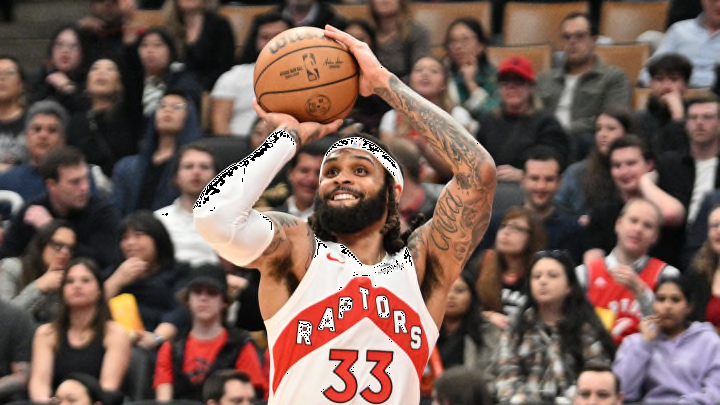
Toronto Raptors: Toronto is set to have cap room in every offseason going forward, but it could snag more by clearing Jose Calderon ($20.3 million over the next two years) or Linas Kleiza, who will miss a chunk of next season after undergoing knee surgery. Kleiza is due $13.8 million over the next three seasons.

Utah Jazz: Mehmet Okur barely played last season because of injuries to his Achilles and back, and he’s owed $10.8 million next season from a team already giving big front-line minutes to Paul Millsap, Al Jefferson and Derrick Favors. Then again, Okur’s deal expires after next season, and Utah probably couldn’t open enough cap room to make using the amnesty provision on the 31-year-old center worthwhile.

Raja Bell was a huge disappointment this season, and the Jazz owe him $6.3 million over the next two seasons. Jefferson is overpaid, but there’s no way Utah is paying him $29 million to waive him.

Washington Wizards: Washington would instantly have more cap room than it would know what to do with if it could clear the $31.6 million in guaranteed money it owes Rashard Lewis over the next two seasons. It would be fitting if both sides of the Arenas swap used the amnesty clause to dump the main players acquired in that deal.

  • Published On 3:46pm, May 17, 2011