The accidental impact of Taj Gibson


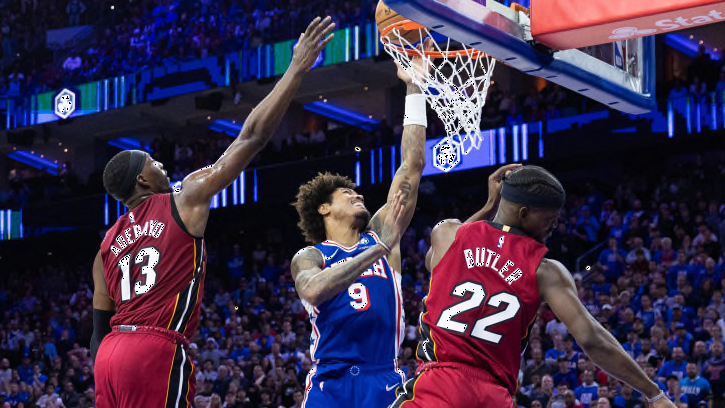
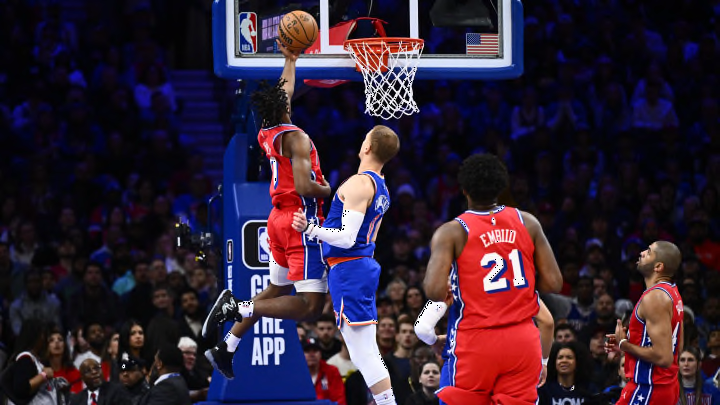
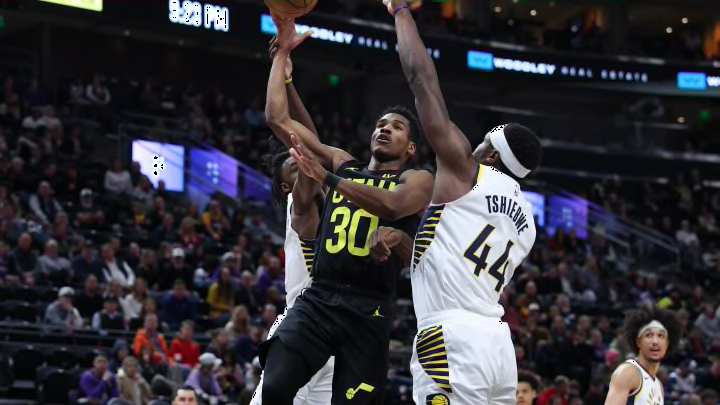
Taj Gibson flashed his athleticism with a pair of monstrous dunks against the Heat in Game 1 on Sunday. (Brian Kersey/UPI /Landov)
The most polite Chicago fans probably just sighed when the Bulls selected USC power forward Taj Gibson with the 26th pick of the 2009 draft. The impolite fans reacted a bit more strongly.
Gibson was 24 then — extremely old for a rookie. It seemed like an odd pick for a team built around a star point guard more than three years younger than Gibson, a maniacal young center (Joakim Noah), an injury-prone small forward (Luol Deng) just two months older than Gibson and an intriguing, hyper-athletic power forward prospect in Tyrus Thomas. The selection of Wake Forest forward James Johnson 10 picks earlier seemed a bit more on point for an ascending team, and the Gibson move seemed even stranger as DeJuan Blair, then a 20-year-old rebounding machine from Pittsburgh, slid into the second round.
Move ahead two years. Circumstances have aligned perfectly, in a totally unexpected and random way, to make Gibson one of the most important players in the Eastern Conference finals — a point that was emphasized with his play in Chicago’s Game 1 victory against Miami on Sunday, when he finished with nine points (including two spectacular dunks), seven rebounds, two assists and two blocks in 23 minutes.
In those two years, the Bulls morphed from intriguing young team to contender faster than anyone expected, making Gibson’s relative old age irrelevant. Thomas broke his arm in a fluky weight room injury early in the 2009-10 season, giving Gibson a chance to start and putting the wheels in motion for the deal that sent Thomas to the Bobcats a few months later. Last summer, the Bulls tossed a pile of free-agent money at Carlos Boozer, an offense-first power forward who struggles on the other end. The move shunted Gibson into a bench role but also guaranteed that he would see important minutes because of his defense. (Meanwhile, the Bulls traded Johnson, the higher draft pick in 2009, to Toronto in February.)
And the Bulls now find themselves facing a team whose rotations and sets scream for Gibson to play a major role. This is most obvious when the Heat shift LeBron James to power forward and go small. The Bulls prefer to keep two big men on the court in this scenario and to have Deng continue guarding James. This means that one of those Chicago big men is going to have to guard a smaller, quicker wing player — usually James Jones.
Chicago’s starting frontcourt is not ideally suited for this. Noah is quicker than Boozer, so the Bulls assigned him Jones duty initially. Noah is certainly capable of chasing Jones around the perimeter, even if he got free for one three-pointer against Noah in Game 1. But that takes Noah out of the paint and forces Boozer into a role as Chicago’s primary pick-and-roll defender — a role in which Boozer generally does not perform well. So coach Tom Thibodeau consistently countered Miami’s small lineups by sending Gibson in for Boozer, and the results were fantastic.
Overall, Miami’s small lineups — groups that obliterated Boston in the second round — got outscored by five points in about 12:30 of playing time, according to Popcorn Machine’s game flow. But that minus-5 margin actually understates Gibson’s effect, because Miami’s small groups twice went on brief flurries when Gibson was off the floor — only to have things reverse themselves when Thibodeau was able to get the reserve big man back in the game.
In one such instance, the Heat sent Jones in the game at the 4:01 mark of the third quarter, and he immediately hit that aforementioned three against Noah. Just 45 seconds later, Thibodeau put Gibson in the game and things swung back Chicago’s way. Gibson guarded Jones and immediately ran him off an open three, forcing Jones to take a dribble inside the arc and attempt a long two. If you can make Jones do anything but catch-and-shoot, you have already won the battle; Jones missed the shot.
On Miami’s next possession, Gibson switched onto LeBron on a pick-and-roll. If this had been Boozer, the Bulls would have been dead. But Gibson kept James in front him and rejected LeBron’s runner in the lane. This was not an isolated thing; Chicago was clearly comfortable having Gibson switch onto James and Dwyane Wade, especially late in the shot clock.
Over that 3:16 span at the end of the third quarter, the Bulls outscored Miami’s small lineup by three points, making up the three they had given up with Noah and Boozer on the court. The entire stretch ended up as neutral in plus/minus terms, but that masks Gibson’s work to some degree.
The pattern repeated itself in the fourth quarter, when Heat coach Erik Spoelstra, probably not by coincidence, chose to go small again at the exact moment Thibodeau swapped Gibson out for Boozer. Gibson sat for a paltry 1:41, and the Heat’s small lineup made up four quick points in that span. Thibodeau sent Gibson back in for Boozer, and the Bulls outscored Miami by five points in the next 55 seconds.
You can’t credit Gibson entirely for that five-point burst; he had little to do with Kyle Korver’s hitting a three in that stretch, and those 55 seconds included just one Miami possession. But the pattern is set: Gibson looms as an effective counter for Miami’s small lineups. And his impact won’t be limited to just those stretches.
When Miami is at its best, it runs motion-based sets designed to get James and Wade into the lane on the move. Stopping those sets requires quick help from opposing big men, and as long as Boozer is guarding the non-threatening Joel Anthony, the onus will be on him to be an active helper. That is not Boozer’s strong suit.
Witness the possession at about the 3:30 mark of the first quarter, when Miami ran one of its pet plays. Chris Bosh and Anthony set up at the elbows as LeBron handled the ball at the top of the arc; Wade lurked in the left corner. James dumped the ball to Bosh at the left elbow and darted down to set a screen on Wade’s man (Ronnie Brewer) in the corner. The goal was to have Wade curl around the screen, flash to the paint, take a pass from Bosh and go to the rim with Brewer trailing.
That’s exactly what happened there, as LeBron’s screen hit Brewer flush and Deng chose to stay on James instead of leaving LeBron to help on Wade in the paint. This meant that Wade was open. Noah, guarding Bosh, couldn’t abandon Miami’s sharpshooting big man, who held the ball as he waited to deliver the pass to Wade. The help had to come from either Boozer (guarding Anthony at the right elbow) or Rose, who was guarding Mike Bibby all the way in the opposite corner. The responsibility was almost certainly Boozer’s, considering how little danger Anthony poses as a potential scorer. But Boozer just stood there watching until Wade caught the pass and rose for an uncontested layup. Wade somehow blew it, but the result does not change the fact that this was the kind of breakdown the Bulls cannot afford.
Boozer’s flat-footed defense became an issue again at the 1:10 mark of the second quarter, when Bosh rolled free into the lane on a beautiful pick-and-roll with James. LeBron sneaked a bounce pass to Bosh, who had no one blocking his path to the rim. There was Boozer, guarding Anthony at the left edge of the paint, clearly in the best position to help. And what was he doing? Standing next to Anthony and pointing at Bosh — screaming too, actually, in classic Boozer fashion. He seemed to be pointing at someone — it’s unclear which teammate — to slide toward Bosh even though that was probably his job. Bosh laid the ball in, and Noah shouted at Boozer and waved his hand, indicating Boozer had to help. (Note: Rose, who was guarding Wade on the right wing, patted his chest to take the blame here, indicating he should have crashed down on Bosh. Perhaps he was right, but Boozer has to react more quickly in a crisis situation regardless.)
This is the trade-off with Boozer, especially when he’s battling a troublesome turf toe injury. Gibson is much better at this stuff, and if Boozer’s slow reaction in help situations ends up hurting Chicago, we might see even more of Gibson in the conference finals. Think about how unlikely that seemed two years ago, when Chicago used a late first-round pick on an unheralded “old guy” from USC.

SI.com/NBA is part of the NBA.com Network. The NBA.com Network is part of Turner - SI Digital, part of the Turner Sports & Entertainment Digital Network.