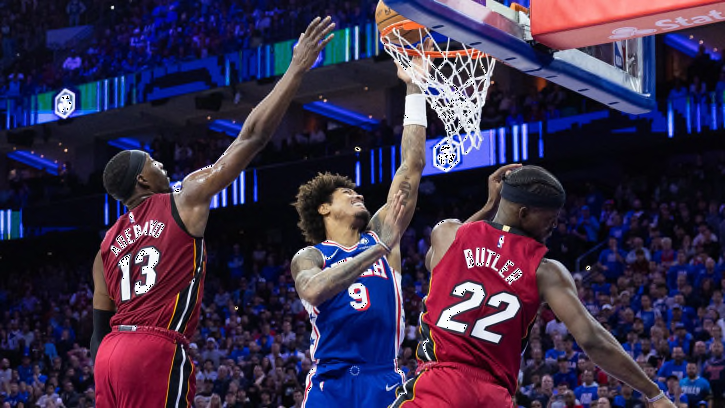
Heat serve notice with dominating win


Chris Bosh had 30 and 12 against San Antonio as the Heat decided to ditch their small-ball game completely. (AP)
It amazes me that every season, NBA fans and media alike get caught up in crazed small-picture narratives when history has told us, consistently, that a few peaks and valleys in the regular season mean very little in the big picture. That is not to say day-to-day stories lack meaning; it’s incredibly important, for instance, that the Lakers have tweaked the way they are defending the pick-and-roll to fantastic early results. Ditto for Doug Collins’ decision a month or so ago to use Andre Iguodala more in a point forward role in Philadelphia. Injuries are imporant, rotation changes are important, stories about a franchise’s inner workings are important.
But over the last week the Heat have reminded us how much energy is wasted wailing over a small losing streak in February or March. The Heat remain a title contender, if a flawed one, just as they have been all season.
Some bullet point thoughts on Miami’s destruction of San Antonio on Monday:
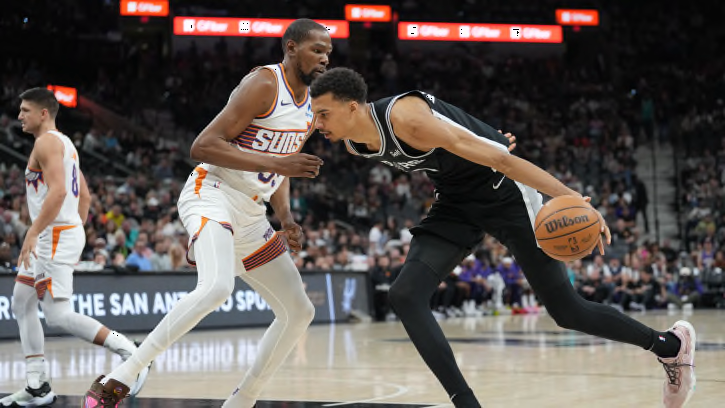
• The story of the game was clearly Miami’s defense of the Spurs’ pick-and-roll attack, and the Heat’s ability to guard that play without conceding the three-pointers that killed them in San Antonio — particularly the corner threes. As Sebastian Pruiti and Kevin Arnovitz have already pointed out, the Heat made no dramatic changes to their pick-and-roll defense. That said, they were much more careful about one thing in particular: They would not give space to the shooter in the near corner.
If Manu Ginobili dribbled to his left around a Tim Duncan screen, for instance, the defender guarding a three-point shooter spotting up in the left corner would stay home. Someone has to help on Duncan as he rolls to the basket, but Miami made sure that person was not the guy defending the shooter in the near corner. Instead, the responsibility of jumping into the lane and bumping Duncan (or DeJuan Blair, or Antonio McDyess) fell to someone on the opposite side of the floor.
The result is to force the ball-handler (Ginobili in this example) to make a tough skip pass. It’s very difficult to do that against a team, like Miami, that is active in passing lanes and quick to close out on shooters when they have time to do it — and a cross-court pass takes time.
• I thought the Heat did a nice job maintaining contact with the Spurs’ big men as they rolled to the basket. When Jamaal Magloire and Erick Dampier defended the screener, they sagged back toward the foul line instead of jumping out on the ball-handler. When Ginobili dribbled left around a high screen, Magloire and Dampier would simultaneously track Ginobili and back-pedal with Duncan. They kept Duncan from roaming completely free, which meant the help defenders didn’t have to come quite as far off of San Antonio’s shooters.
• The Spurs seemed to have more success drawing help from the outside when Blair served as the screener. Blair is quicker than Duncan, and he’s more comfortable slipping the screen — basketball lingo for darting down the lane before really setting the pick. The suddenness of that action — and Blair’s speed — makes it nearly impossible for the two Heat guys defending the pick-and-roll to keep close to Blair, and thus forces more help.
• Another small thing: On a few pick-and-rolls, the Miami guard defending the ball-handler would go under the screen, and, while doing so, would give the screener a big old shove, delaying his roll to the hoop and (again) limiting the help needed to contain the play. Watch Mario Chalmers do this on San Antonio’s last possession of the first quarter for a good example.
• Last week, I wrote that Heat’s biggest new problem was the fact that Erik Spoelstra did not trust any of their big men (other than Chris Bosh) and thus was going small more often and for longer stretches than he had intended — and that Miami’s small lineups weren’t faring nearly as well as they had earlier in the season, when they were a short-spurt gimmick.
Spoelstra has ditched the small ball completely over the last three games. I thought perhaps that had more to do with Miami’s first two opponents in this winning streak (Memphis and the Lakers, both big teams), but Spoelstra kept the pattern up against the Spurs, who love playing small ball and did so in the second half last night.
• People who say the Heat are running a stagnant offense should re-watch this game. I can’t remember Wade and James screening for each other, both on and off the ball, as often as they did Monday night. The results were fantastic — they created space for each other, drew switches and generally had the Spurs on their heels.
The possession at about the 1:20 mark of the second quarter was typical, and encouraging: As Chalmers brought the ball up the left sideline, LeBron James positioned himself at the foul line and set a back screen on Wade’s man (Ginobili), freeing Wade to cut to the basket. Ginobili fought through the screen, denying option No. 1. James then popped out and set a quick screen for Chalmers on the left wing. The pick forced a switch, leaving Tony Parker on James, and gave James a brief window of space on the left sideline. Chalmers couldn’t find a passing lane and James did not immediately go to the block against Parker. Option No. 2 denied.
But as that was happening, Wade cut baseline and then curled up the weak side around two screens — first from Bosh, then from Magloire. He popped up at the right elbow, took a pass from Chalmers and fired up a relatively open jumper. He missed, but option No. 3 was a success.
And guess what? There was an option No. 4, too, as Bosh popped out along the right baseline and got free for a mid-range jumper while his guy (McDyess) patrolled the lane in case Wade decided to drive.
This stuff happens every game. Ignore it if you want (or if you focus only on the bad clutch possessions, which are an issue), but it’s there.
• When I watch plays like the one above, I wonder how good this team could be if Wade or James ever developed into a truly great jump-shooter. Their shaky jump-shooting has been a criticism of each guy through their entire careers, but it didn’t matter quite as much in prior seasons, since each of them served as the lead ball-handler on their respective teams. Now that one will always be working off the ball, an elite jumper would be even more useful.
• As or the Spurs, people will want to say they are in trouble now, after the Lakers and Heat handled them. They are in the midst of a little defensive slump, and they clearly have issues against active power forwards with post-up games and legit range out to 20 feet. Most of their bigs aren’t quick enough to handle those guys, and the ones who are lack the height (Blair) or strength (Matt Bonner, man-handled last night) to deal with them.
These aren’t new issues, though. San Antonio’s defense has gone through bouts of inconsistency all season. Overall, this team remains as strong as ever, and even if the league’s elite have figured out how to play it a bit more effectively, San Antonio is talented enough to adjust, and to have nights where it’ll win no matter what the opponent does.

SI.com/NBA is part of the NBA.com Network. The NBA.com Network is part of Turner - SI Digital, part of the Turner Sports & Entertainment Digital Network.