Value of offensive boards diminishing?


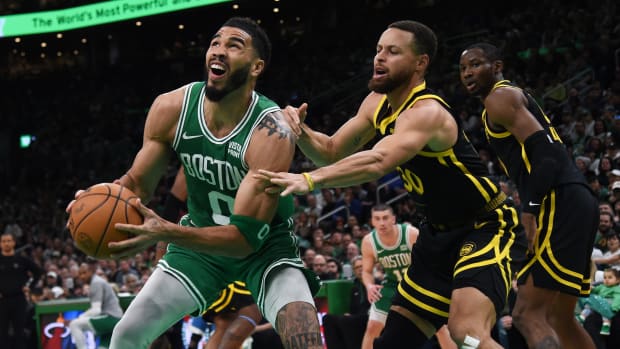
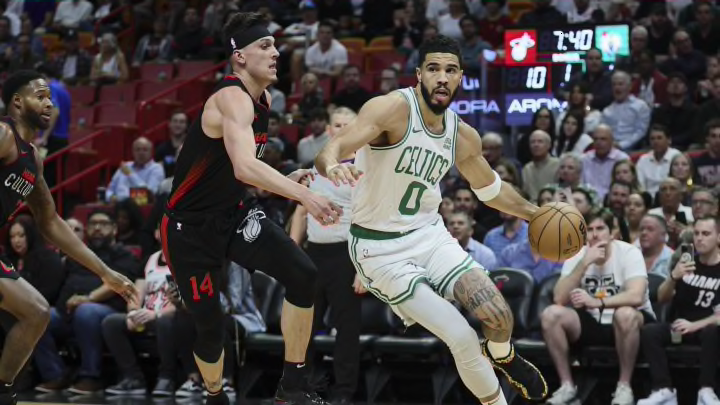
The Celtics' lowly offensive rebounding rate -- not rebounding average -- may earn a spot in the history books. (Elsa/Getty Images)
The next time Reggie Miller announces a Celtics game, he will probably refer to the Celtics as the worst rebounding team in the league, and some fans watching the game will then repeat that line to their friends in the kinds of debates we all have. I hope a lot of viewers understand how wrong Reggie Miller is about this.
Miller means to say that the Celtics average fewer rebounds per game than any team in the league — something that has been true most of this season, but isn’t right now, since the Pistons have slipped below the Celtics in raw boards per game. But clearly that number means little in terms of evaluating a team’s rebounding ability. What matters is rebounding rate, the percentage of available rebounds a team gets, which can be measured on both offense and defense. And when you look purely at defensive rebounding rate, you see the Celtics rank ninth in the NBA. Pretty good for the worst rebounding team in the league.
Boston ranks dead last in offensive rebounding rate, which is the main reason it averages so few total rebounds. To hold this against the Celtics is to ignore a basic fact about them: They don’t care very much about offensive rebounding. Like a lot of elite teams — the Heat, Spurs, Magic and LeBron-era Cavaliers, for instance — Boston wants most of its players to get back on defense instead of crashing the boards. Toss in the fact that Boston shoots better than any team in the league, and it’s not going to end up with a lot offensive boards.
As a side note, that doesn’t mean there’s nothing interesting to see with Boston’s rebounding. If not for a recent spurt of offensive rebounding from Nenad Krstic, the Celtics might well be on pace to be the very worst offensive rebounding team in NBA history, which is to say they have a chance to post the lowest offensive rebounding rate in the entire recorded history of the league. As things stand now, Boston has rebounded 21.5 percent of its own misses; the league average is 26.4 percent, and the 29th-ranked team, the Nuggets, are all the way up at 23.7 percent.
Only one team has ever finished a season with a lower offensive rebounding rate than Boston currently sports: last season’s Golden State Warriors, who may well be the worst rebounding team ever, having finished dead last in both offensive and defensive rebounding rate.
The larger story is that the league as a whole seems to be moving away from viewing the offensive rebound as an important weapon. For the second straight year, the league has a pretty good chance to post the lowest overall average offensive rebounding rate in its history, or at least back to 1974, the first year in which Basketball-Reference has reliable public data on the stat. Last season’s league-wide average of 26.3 percent was the lowest on record. The Timberwolves currently lead the league with an offensive rebounding rate of 30.8 percent, a mark which would have placed them 19th out of 23 teams in the 1983-84 season.
This is not a new thing. Coaches such as Doc Rivers, Stan Van Gundy, Tom Thibodeau, Gregg Popovich and many others have talked openly about why they prioritize transition defense over offensive rebounding, and NBA folks ranging from Donnie Walsh to Reggie Evans reflected on the death of the offensive rebound in a piece I wrote last season for NYTimes.com. It’s a well-known strategy, which is why it’s frustrating to hear guys like Miller lambaste the Celtics (and other such teams) based on their low rebound totals — and why it was so refreshing to hear Steve Kerr rebut that argument, with liberal mention of rebounding rate, during a recent Boston game on TNT.
It’s not a coincidence that Kerr has attended the MIT Sloan Sports Analytics Conference in the past, or that he served as the top personnel guy on the Phoenix Suns. One of the questions people ask at Sloan every year is how to best translate advanced stats to the general public so they eventually become part of the common language, just as OPS has in baseball, for instance. Rebounding rate strikes me as a stat so simple that to call it “advanced” is silly. It’s a measure of percentage — the kind of thing we all learn to do in elementary school. (Or middle school? I can’t remember when kids learn percentages). And yet it tells us so much more about the game that raw rebounding total, which remains the stat lots of the key voices — especially on television — use to make their points.
It’s rebounding rate. Learn it. Love it.
As for the Celtics, they do have a chance to eclipse the Warriors and carve out a trivial place in league history. It will be more interesting to see what happens with the return of Shaquille O’Neal, their best offensive rebounder this season, and the start of the playoffs, when Boston might adjust its game in small ways.

SI.com/NBA is part of the NBA.com Network. The NBA.com Network is part of Turner - SI Digital, part of the Turner Sports & Entertainment Digital Network.