Monday Musings: Defensive issues mute Jazz

Decrease fontDecrease font
Enlarge fontEnlarge font

The Jazz have lost four straight on the road, including a 24-point blowout in Boston. (Damian Strohmeyer/SI)

We’ve entered the NBA’s dog days now, and when a team starts stumbling in January and February, it’s hard to know whether to dismiss the struggles as products of midseason malaise or worry about deeper problems. Last year’s Celtics, 27-27 over their last 54 games, are the most recent reminder that overreacting to a midseason slump can be dangerous.

But it’s worth looking at what’s going with Utah. A Jazz team that once looked like it might develop into a legitimate contender just wrapped up an 0-4 road swing through the Eastern Conference in which it struggled to compete against the Nets, Wizards and Sixers. The Jazz’s loss in Boston — a 24-point whipping — wasn’t a shock, but it was jarring to watch Utah mount late rallies just to get back into games against two certain lottery teams and one borderline playoff contender. Deron Williams is complaining about the team’s defense and subtly pushing Jerry Sloan to tweak the starting lineup, which has left Utah trailing after almost every first quarter. Sloan finally made a change against Philadelphia on Saturday, when he inserted Gordon Hayward for Andrei Kirilenko — to mostly disastrous results.

The four-game whitewash represents the nadir of a two-month trend that deserves some hand-wringing: the total regression of Utah’s defense, which started the season in top-10 form and now looks like a liability.  As John Hollinger noted at ESPN.com, the Jazz sported the lowest opponent field-goal and three-point percentages in the league in early December. They had held teams to 42.5 percent from the floor and 30.7 percent from deep. That helped Utah make up for two bad early-season trends.

One — a recurring problem for the Jazz — is no one fouls more than they do. Opponents have long feasted at the line against Sloan’s teams, and that doesn’t figure to change.

The other — a new issue as of December – is the Jazz’s inability to protect the defensive glass.

Over the last six weeks or so, the nightmare scenario for Utah has played out. Both of those early problematic trends have continued, while opponents have started to make shots. Teams shot 46 percent from the floor (and 39 percent from three) against the Jazz in December; those numbers have jumped to 47.3 percent and 40 percent so far in January. Meanwhile, the Jazz still give up the most free throws per shot attempt, and, most disturbing of all, they’ve settled in at 27th in defensive rebounding rate. The latter trend is especially disturbing, because Utah ranked fifth in that category last season, meaning their defensive rebounding has collapsed much more dramatically than we should have expected given the loss of Carlos Boozer (a better rebounder than either Al Jefferson or Paul Millsap).

In fact, only seven teams since 1973-74 have seen their place in the league’s defensive rebounding hierarchy (as measured by percentile rather than raw rank, given the changing number of teams in the league) drop further in one season than Utah’s has so far, according to Basketball-Reference.

A deeper look at Utah’s defense suggests the problem lies in the pick-and-roll — and specifically in its inability to stop dribble penetration at the top. An exhaustive look at video points to, primarily, the inability (or reluctance) of Millsap and Jefferson to jump out aggressively and cut off ball-handlers before they turn the corner. For whatever reason, both prefer mostly to sag back as Williams chases point guards over screens. That’s fairly common, and good big men can drop back and still manage to cut off a ball-handler if their positioning is sound and their feet are quick.
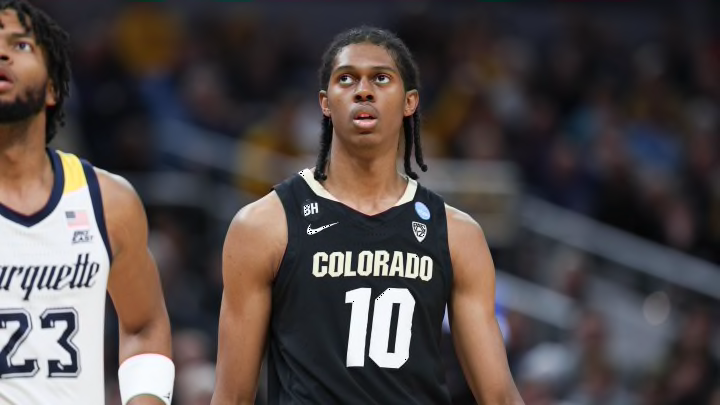
Jefferson and Millsap can’t pull off the trick consistently. And when point guards get into the teeth of a defense, bad things happen — open shots, fouls and offensive rebounds that result from Utah’s big men having to help on the pick-and-roll action.

The numbers bear this out. Only three teams allow a higher points per possession mark on spot-up opportunities, according to the stat-tracking service Synergy Sports. I’d wager that a large percentage of those open looks comes off of pick-and-rolls. Utah’s defense is also allowing significantly more points this season on pick-and-roll plays when the ball-handler finishes the play with a shot, drawn foul or turnover, according to Synergy. Utah ranked second last year in defending such plays; it’s 18th this season.
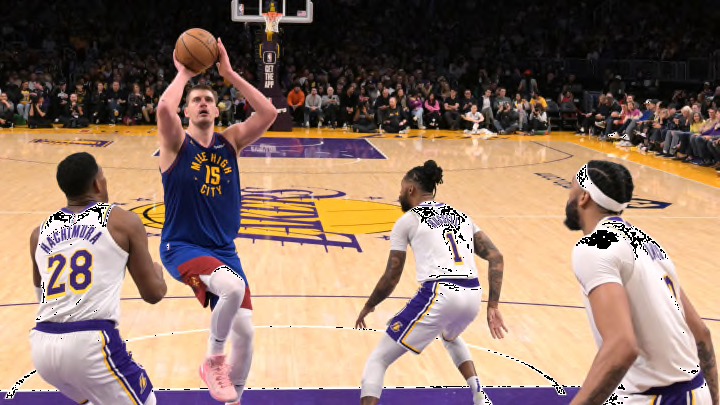
It would be easy to blame Williams for this, but it’s unreasonable to expect point guards to consistently stay in front of their counterparts on pick-and-roll plays. Williams is a generally solid (if not elite) defender, and though his size might make it harder for him to squeeze over screens in the vein of Rajon Rondo or Chris Paul, he’s mostly doing his part; he needs more help from his big men.

There don’t appear to be any easy answers here. Five of Utah’s six most commonly used lineups (including the starting lineup Sloan used until Saturday) have been atrocious defensively, and four of those five groups include the Millsap-Jefferson pairing. Lineups including at least two bench players have generally fared much better, but those lineups won’t score enough over the long haul for Sloan to realistically play them heavy minutes.

A four-game losing streak — even a bad one like this, which is the Jazz’s longest in almost exactly two years — isn’t a crisis. Utah is still going to make the playoffs, and it has a decent chance at snagging home-court advantage for the first round. But it will be hard to see the Jazz as a playoff threat if their defense in April looks more like the sieve it’s been over the last two months than the stifling machine it was through early December.

__________________________________________________________________________________

10 THINGS I LIKE AND DON’T LIKE


We'd like to see more of this from Blake Griffin. (Andrew D. Bernstein/NBAE via Getty Images)

1. Blake Griffin’s left hand


This would be my offseason project for the Clippers’ rookie: figure out how to finish inside with his left hand. Griffin likes to face up on the left side of the floor and break his man down off the dribble. When he does this, whether he spins to the middle or goes baseline, he invariably finishes with his right hand — even though in doing so he brings the ball closer to the middle of the paint, where more guys can whack at it. If Griffin can develop a reliable lefty finish, the league is doomed.

2. Ralph Lawler, a gleefully slobbering mess

The Clippers’ Lawler has long been one of my favorite play-by-play guys (some unfortunate remarks about Hamed Haddadi notwithstanding), and Griffin this season has transformed Lawler into the happiest announcer in the game. The volume and enthusiasm are way up on Lawler’s (awesome) trademark exclamations — “Slaaaaam Dunk!”; “Oh me, oh my!”; and “Bingo!” for made three-pointers — and he has run out of ways to praise Griffin. A joyous listen.

3. Detroit’s offense with Tracy McGrady, Rodney Stuckey and Tayshaun Prince on the court

This is more of a dislike than a like after a brief honeymoon period where it was interesting to watch Stuckey adapt to his new role as Detroit’s de facto shooting guard while he, McGrady and Prince formed a weird trio bound to create at least one mismatch. But it has since devolved  into confusion and stagnation. Stuckey is understandably figuring things out, and Detroit’s offense with all three of these guys too often ends up with a Prince isolation (something he’s quite good at in the right matchup) or McGrady running a late-shot-clock pick-and-roll with a Detroit big. The other guys? They’re often left standing around.

4. Beno Udrih, King of the PUJIT

I have a theory about Udrih: If you took a non-fan and plopped him in front of the TV during a random 10-minute stretch of a Kings game, there’s at least a 50 percent chance that fan would come away assuming Udrih was the best player on the court and one of the best in the world. (Note: This assumes the non-fan would not really understand how to judge defense.) Udrih can go on sick scoring runs, and it seems like he never misses the dreaded PUJIT — the pull-up jumper in transition.

Derek Fisher is the player most associated with the PUJIT, but Udrih is the shot’s true muse.

5. Taj Gibson’s help defense

Chicago’s Gibson is slumping on offense and we’re all fawning over Kurt Thomas’ ageless defense, but don’t overlook Gibson’s fantastic defense both on his own man and especially as a helper. Gibson is swatting 2.6 shots per 36 minutes, making him one of just 11 guys in the league (minimum 400 minutes played) averaging at least 2.5 blocks per 36. The other 10 on the list are limited role players (Larry Sanders) and well-known masters of the blocked shot (Andrew Bogut, Serge Ibaka, Samuel Dalembert, JaVale McGee and others).

6. Andris Biedrins’ help defense

Biedrins has strangely turned into maybe the least intimidating 7-footer (or player 6-11 and taller, depending on which measurements you believe) in the league. He’s blocking shots at a career-low rate, and he has looked a step slow in rotating for much of the season. Golden State needs much more from Biedrins if it wants to realistically contend for the final playoff spot in the Western Conference.

7. The Kevin Durant decoy

Durant runs around baseline screens, Ray Allen- and Rip-Hamilton-style, quite a bit in the Thunder’s offense as Russell Westbrook handles the ball up top, waiting to hit Durant with a pass as he curls off the final screen. But once in a while, Durant will veer off his usual pattern and set a surprise screen for Westbrook, creating an unexpected pick-and-roll for the defense to deal with. Other teams run this sort of misdirection, but few screeners in this set draw the sort attention Durant does.

8. The on-court microphones in Denver and Philadelphia

I’ve long been a fan of the Sixers’ local broadcast, in part (or perhaps entirely) because it is doing something to enhance the sounds of the game. I have no idea what it is, but every noise is louder and crisper on a Philadelphia broadcast — the sound of the ball going through the net or clanking off the rim, the shoes squeaking, the coaches yelling, everything. And lately, I’ve noticed the same enhancements in Denver, with the added bonus that we get to hear Kenyon Martin constantly saying bad words. Fun times.

9. Rajon Rondo, at the elbow or in the post

You see this more and more with the Celtics as they grow more confident in Rondo’s ability to do just about everything. Setting up with Rondo at the elbow, back to the basket, allows him to direct the offense without moving around as much on his occasionally sore legs, since other players move around him as he surveys the scene.

One favorite to watch for: If Rondo is on the right side, Paul Pierce will come up from the baseline, take a hand-off from Rondo and curl around a pair of screens set just above the foul line. At the end of all this, Pierce is in prime position to get to the rim or take a mid-range jumper form his favorite spot.

10. Luol Deng’s skyrocketing minutes

This isn’t a knock on Bulls coach Tom Thibodeau, whose has limited frontcourt options and has managed to limit Deng to 38 or fewer minutes in three of Chicago’s last five games. But I’m worried about how Deng will feel when the playoffs arrive. Only two players — LaMarcus Aldridge and Monta Ellis — have played more minutes than Deng, and the pounding he takes during those minutes has jumped as he’s had to spend more time at power forward. The only good news: Boozer is back from a sprained ankle, so perhaps the burden on Deng will ease a bit.

  • Published On 12:42pm, Jan 24, 2011