The Bulls miss Noah most on … offense?

Decrease fontDecrease font
Enlarge fontEnlarge font

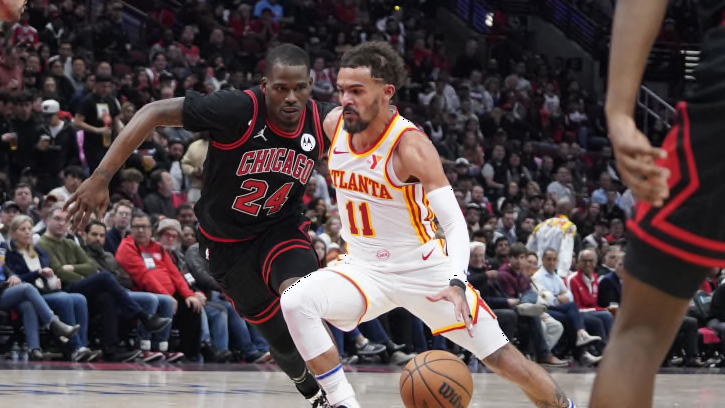
Joakim Noah's value on offense is greater than most people realize. (Ron Turenne/NBAE via Getty Images)
Bulls center Joakim Noah is regarded (derisively in some circles) as a “hustle player” who provides “energy” and “intangibles.” This is fan-speak for saying that a player has limited skills, especially on offense, but makes up for it by trying really hard. If Noah has any obvious skills, most folks would tell you they come at the defensive end, where he skitters around, blocks shots and grabs rebounds.

And yet, in Noah’s 14-game absence to recover from hand surgery, the Bulls’ offense has struggled while their defense has remained stout. Using Hoopdata.com’s points per possession metric (which differs slightly from the one I usually use — on Basketball-Reference), we see Chicago has scored slightly more than 103 points per 100 possessions this season. That’s just about league average.

Since Noah was sidelined, Chicago has hit that mark just six times in 14 games despite an incredibly easy schedule, and it’s come in at 102 points per 100 possessions or worse — the equivalent of a bottom-10 offense — in seven of those 14 games. Toss out one huge outlier — a 121-76 destruction of the Sixers last month — and the Bulls’ offensive numbers without Noah look even worse. Their defense, meanwhile, has shot to the top of the league in points allowed per 100 possessions.

The level of competition obviously matters over such a short sample, and Chicago’s Noah-less defense has clearly benefited from playing some of the league’s worst offensive teams. Eleven of those 14 games have come against the Nets, Cavaliers, Clippers, Sixers, Wizards, Bobcats, Pistons and Bucks — eight of the league’s dozen worst offenses, with five of those teams ranking in the bottom five. So the Bulls’ D is fattening up against some poor competition.

But only one of those teams (the Bucks) ranks among the league’s top 10 defenses, so the Bulls’ struggles on offense are troubling. And they raise the question: Is Noah more valuable on offense than most people realize?

The easy answer is yes, simply because he’s not Kurt Thomas, who is receiving the bulk of Noah’s minutes. Thomas is working hard and playing solid defense, but he’s just not a moving threat on pick-and-rolls. It seems like it takes him twice as long to set a screen and get to the rim as it takes Noah, and that slowness means defenses don’t have to pay Thomas lots of attention. When Luol Deng sneaked a pass to a rolling Thomas late in Wednesday’s loss to the Bobcats, it surprised me because the play took so long to unfold I thought the Bobcats would be able to deflect the pass even though it clearly wasn’t their primary concern.

Back to Noah. The Bulls have scored about four more points per 100 possessions with Noah on the floor versus with him on the bench this season. That’s a big number, but it’s at least partly the result of his sharing lots of time with Derrick Rose. Last season, Chicago scored at just about the same rate regardless of whether Noah was in the game.

The Bulls are shooting about 47 percent without Noah — right at their season average. They’ve turned the ball over a bit less often, and they’re gotten to the line at a slightly higher rate.

So what’s wrong? Why are the Bulls scoring less without Noah if all of those fundamental things remain in place? Two reasons:

1) Their three-point shooting has fallen off a cliff. Chicago has shot 61-of-200 (30.5 percent) in it last 14 games, a terrible mark that would rank last in the league over the full season. It’s not just the shooting percentage, either. Those 200 attempts work out to about 14.3 per game; the Bulls were averaging 16.1 three-point attempts before Noah opted to have surgery on his thumb.

This could all be a coincidence. The Bulls aren’t a great three-point shooting team anyway, so perhaps they’ve just hit a prolonged slump. Or this could be evidence of an intangible that isn’t really an intangible, since you can see it if you look carefully: Having an active big man in the paint — one who’s a threat to score with either hand — opens up spacing on the perimeter.

2) The team’s offensive rebounding has fallen off a bit. Chicago is one of the best offensive rebounding teams in the league, but it has rebounded just 24.5 percent of its own misses over the last 14 games. That would rank Chicago somewhere in the low-20s in offensive rebounding rate. As it is, the Bulls actually rank seventh, having rebounded 28.3 percent of their own misses over the full season, according to Basketball-Reference. They were up near 30 percent before Noah’s surgery.

That difference — between 30 percent and 24 percent — amounts to about two or three offensive rebounds per game. That might not seem like much, but it is. The Bulls’ last five losses have come by an average of 4.4 points, and in most NBA games, an extra possession or two can make a big difference.

(Update: One thing I didn’t originally include here, perhaps because it is such a tangible thing: Noah is a fabulous passer, and the absence of a big man who can facilitate from the elbow and make precise quick-hit interior passes obviously hurts, too.)

One possible way (in theory) coach Tom Thibodeau might be able to get Chicago’s offense going: play Taj Gibson and Carlos Boozer together more, with Boozer shifting to center. (To be clear: Thibodeau has done this since Noah’s injury.)

The two have played together in five different lineups that have logged at least five minutes, according to Basketball Value. The results from those lineups:

• Chicago has scored 253 points on 221 possessions — or 114.7 points per 100 possessions, a mark that would lead the league.

• Chicago has allowed 223 points on 215 possessions — or 103.7 points per 100 possession, a mark about the same as that of the league’s 10th-ranked defense.

It’s pretty clear Boozer-Gibson lineups can score, but that solid defensive figure masks the fact that these groups have had some trouble on that end. One of those five lineups — the one that has logged the second-most minutes together — has destroyed opposing offenses, holding them to just 37 points on 57 possessions. (Side note: That lineup — Boozer, Gibson, Rose, Deng and Kyle Korver — has been brilliant on both ends in 32 minutes of court time together.)

One of the other five Gibson-Boozer combinations has done well defensively, but the other three have yielded pretty big scoring totals, and you can understand why Thibodeau is hesitant to give them major run. But if  Chicago runs into consistent scoring trouble, this is one thing to watch for.

  • Published On 1:56pm, Jan 13, 2011