Should Knicks bother trading for Carmelo?


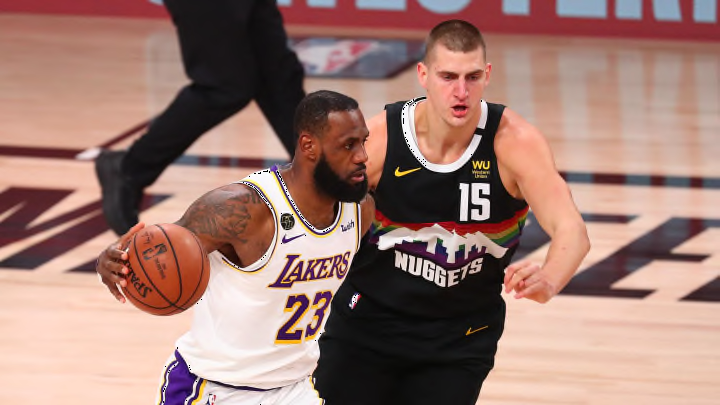
Carmelo Anthony reportedly told Denver he would only sign an extension if the Nuggets trade him to New York. (Nathaniel S. Butler/NBAE via Getty Images)
The Carmelo Anthony trade landscape changed at least a bit on Sunday, when ESPN.com’s Chris Sheridan reported that the forward had informed Denver’s front office that he would sign a contract extension only if the Nuggets trade him to the Knicks. This would presumably mean Anthony has told the Nuggets that he will not sign the three-year, $65 million extension they offered months ago, and that he would not accept similar deals with suitors other than the Knicks.
On the surface, this puts the Nuggets and new general manager Masai Ujiri in a weak position. Teams such as the Nets, regarded as the club with the best package for Carmelo right now, would seem less likely to offer the same bounty for Anthony if they’re pessimistic about their chances to sign him long term. And the Nuggets, of course, would stand to lose Anthony for nothing if they don’t trade him to the Knicks — a path Ujiri doesn’t want to go down after watching the Raptors lose Chris Bosh without getting close to equal value.
This could all be a big bluff on Anthony’s part to try to force Denver’s hand. After Sheridan’s story broke, a number of other reporters, including Frank Isola of the New York Daily News and Benjamin Hochman of the Denver Post, tweeted that the situation was more complicated, and that Anthony would consider signing extensions with other teams.
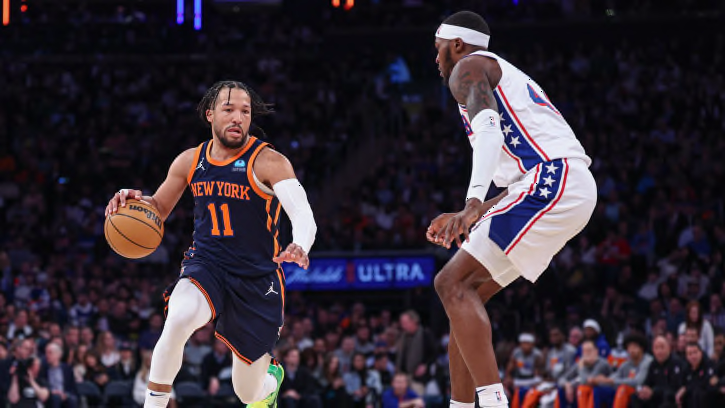
The more interesting question, to me, is whether the Knicks should bother trading for him. To do so, they’d likely have to acquire a first-round pick to sweeten their offer, and they are reportedly open to dealing Anthony Randolph to grab that pick. They’d then flip that pick, along with Eddy Curry’s expiring contract and two of the following three players: Danilo Gallinari, Wilson Chandler and Landry Fields.
That is a steep price to pay for Anthony, especially when there’s at least a chance he’ll hit the open market as an unrestricted free agent this summer. Gallinari, Chandler and Fields are valuable young pieces to New York, and all are improving on both ends of the floor. Giving up two of them for Anthony would hurt the Knicks’ depth, even if it would give them an elite wing scorer to play alongside the Amar’e Stoudemire-Raymond Felton pick-and-roll combination.
Of course, many New York fans are quick to argue that trading for Anthony would be the best way to entice Chris Paul to sign with the Knicks after the 2011-12 season, when the Hornets’ point guard can become a free agent.
That’s where the collective bargaining uncertainty kicks in. If the Knicks were to surrender Randolph, Gallinari and Fields in Carmelo-related deals, and pay Anthony about $20 million per season, they would have about $59.7 million committed to nine players for next season — and that’s assuming they’ll pay Chandler the $3.1 million they must offer him to retain matching rights. If they renounce those rights to Chandler, they can get down to about $56.5 million; if they sign Chandler to a reasonable deal, they’ll likely be north of $62 million.
The current salary cap is about $58 million. No one knows what it will be next season, or if there will be a mid-level exception, or whether current contracts might be rolled back.
And what about after the 2011-12 season, when Paul would presumably be New York’s main target? In a theoretical scenario in which the Knicks renounce their rights to everyone save Stoudemire and Anthony, they’d have $40 million committed to just those two stars for the 2012-13 season. If Chandler is still around, that number figures to be about $46 million or $47 million.
Does that leave enough room to sign Paul? There’s no way to know right now. The Knicks could gamble that a rollback of current salaries might open up a bit more room, but that’s a gamble — just as clearing an entire roster in order to sign a star free agent is a gamble, one New York has already played.
There’s also the fact that the Knicks are scoring at an elite level already. They’re fourth in the league in offensive efficiency, and they’re threatening to dislodge Phoenix from the third spot. Scoring has not been New York’s problem, at least against the atrocious defenses they’ve faced the last three weeks. Over their next dozen games, New York plays Boston, Orlando, Miami (twice), San Antonio, Chicago, Indiana and the Lakers. That’s eight games against teams ranked in the top 10 in points allowed per possession.
In other words: We’re about to learn a bit more about how good New York’s offense really is, and whether it might need an elite isolation scorer to compete against top teams.
If New York’s offense continues to function this well, I see little need to break the bank for Anthony. New York needs help on defense, where it ranks 23rd in points allowed per possession. Anthony is not a difference-maker on defense, and that’s putting it nicely.
All the attention now is on Ujiri and the tough position the rookie GM finds himself in. But New York’s front office is in just as difficult a position.
______________________________________________________________________________
10 THINGS I LIKE AND DON’T LIKE
1. Dallas, making the zone defense cool
The guys at Hoopspeak nailed this last week: Dallas may already have the best zone defense in NBA history, and we’re only a quarter into the season. How much the Mavs break out the zone depends on their opponent, the rhythm of a particular game and how worried they are about giving up offensive rebounds. But they use it in every game, for long stretches, and they have the length and smarts to make it work. They use it as a weapon, not as a crutch the way Phoenix did in the playoffs last season to make up for its poor man-to-man defense.
Jason Kidd can’t defend quick point guards anymore, but his ability to defend 2-guards and even small forwards in a pinch — the sort of improvisation that is critical at times in a zone — is an underrated skill Dallas uses well in both zone and man-to-man.
The Mavs are sixth in the league in points allowed per possession, yielding a number that would have topped the entire league last season. They’ve hovered around the top 10 in defensive rebounding, so the zone isn’t killing them there.
It will be interesting to watch how teams game-plan for the Mavs’ zone as the season goes on and especially during the playoffs.
2. Al Jefferson, cold from the mid-range
It’s probably just a blip as Jefferson adjusts to his new team, but his mid-range shooting has started cold in Utah. Big Al is putting up career-worst shooting percentages in every area from the rim to the 15-foot mark, and his patented push shot has been especially inconsistent.
Jefferson has been fine on long two-point jumpers, so this figures to turn around for a Utah offense that is top-10 quality already.
3. Another Shannon Brown campaign
I’m a fan of Shannon Brown. His emergence as a knock-down three-point shooter is a testament to his hard work and one of the nice storylines of the early season.
But we do not need to suffer through another over-the-top campaign to get Brown into an All-Star weekend event — the three-point shootout. The “Let Shannon Dunk!” thing was cute last season, when Brown was an unheralded role player emerging as a legitimate part of Phil Jackson’s rotation. I don’t even care that he blew the dunk contest so badly; that could happen to anyone.
Brown’s a borderline household name now, at least in houses occupied by NBA fans, and so I cringe when I come across the occasional “Let Shannon Shoot!” tweets and pleas for him to get into the three-point contest. Do people really care about this? Do people care, right now, that Daequan Cook is a past shootout champion?
Brown will make it on the merits, anyway. Let him do that, quietly.
4. The double-post chemistry in Memphis
It’s one of my favorite sets in the league: Marc Gasol sets a high screen for Mike Conley and rolls down the left edge of the paint. As Gasol gets inside the foul line, Zach Randolph suddenly bolts into post-up position on the opposite edge of the paint, putting his defender on his back. Randolph thus forces his defender to stick with him instead of helping on Gasol.
I like this play best when Conley zips an entry pass to Randolph, and Randolph then flicks a one-handed lefty dish to Gasol for a layup. It’s a nice, quick-hitting play, and one few teams have the low-post personnel to run.
5. LaMarcus Aldridge, chasing those guards
You know how much I enjoy when Steve Nash draws a switch and gets to break down a helpless big man. But he didn’t enjoy it much last week in two games against Portland, primarily because Aldridge has shown a rare ability to contain point guards on switches. He’s quick enough to keep up with them on drives without yielding a ton of space they can use to shoot an open jumper.
6. The regression of Carl Landry
A year ago, Landry was one of my favorite players in the league — a spark plug off Houston’s bench who could score at the rim and from mid-range, and was not afraid to bang inside.
That player has mostly vanished this season in Sacramento, and not just because his minutes are down as part of a Kings frontcourt full of (theoretical) untapped potential. His shot attempts at the rim have dropped by half from last season, but he’s still taking the about same number of long twos despite his drop in minutes.
And his rebounding … oh my, his rebounding. Landry is the only player listed at 6-foot-8 or taller who has logged at least 200 minutes this season and grabbed fewer than 10 percent of available defense rebounds, according to Basketball-Reference. He is making Rashard Lewis and Hedo Turkoglu look like Dwight Howard, and he’s doing it on a team that ranks worse than the league average in overall defensive rebounding.
This makes me sad. Let’s move on.
7. The cutting Nene
When Denver’s Nene is active off the ball, he’s a joy to watch. When he sets a screen for Carmelo on one of the wings, he’s great at slicing to the rim in a way that gives Anthony a good angle to pass him the ball. But he’s a good cutter even when he’s not involved in the primary pick-and-roll play. The Nuggets run a lot of action where one big man (often Shelden Williams) rolls to the rim and draws the attention of the defenders, who are often then surprised when Nene rolls through the lane a beat behind Williams, almost like a running back following his fullback. And you know Nene can finish.
8. An active pick-and-roll for Kevin Durant
When Russell Westbrook and Kevin Durant run a pick-and-roll with the latter as the screener, it’s often a passive play, designed to force the defense to switch a point guard onto Durant. Very often, Durant doesn’t even move, content to post up the point guard from the top of the key and shoot a jumper over him. It’s a play many teams run for scoring small forwards who have solid mid-range games.
Over the weekend — and especially against New Orleans on Friday — Durant was rolling to the hoop and flashing into the lane like a big man. It’s not his strong suit, but it introduces more movement into Oklahoma City’s offense and forces the defense to scramble and leave other guys open. Serge Ibaka especially is becoming really good at finding the open spaces Durant’s movement creates.
9. The Golden State bench
Check out the plus/minus numbers, and you’ll see that the Warriors’ starting five is among the best five-man units in the league among those that have played a lot of minutes together. Introduce a single bench player, and things generally go south. This is the price you pay, I guess, for giving up three rotation players in exchange for David Lee and dealing another (Corey Maggette) for two expiring contracts (Dan Gadzuric and Charlie Bell). The Warriors have to. hope that Louis Amundson, who made his season debut last week, can at least help a little bit.
10. The consistency of Tayshaun Prince
Here are the Detroit forward’s Player Efficiency Ratings for the past seven seasons, in order: 16.2, 14.8, 16.0, 15.6, 15.0, 16.0, 15.1. For his career, Prince’s shooting percentage has never been worse than 44.9 percent or higher than 48.7 percent, and it sits now at 47.9 percent.
His rebounding averages, per 36 minutes, go like this for the past five seasons: 5.1, 5.3, 5.6, 5.4, 5.3.
His three-point shooting has gone up and down a bit more (and it’s up this season), but Prince’s overall consistency is stunning. Any team that deals for Prince and his expiring $11.1 million contract will know precisely what it is getting. He’s still a solid, rangy defender, and he can initiate the offense from the post or the wing. He can be a bit of a ball-stopper, and he’s clearly been something of a malcontent this season, but Prince can be a key player for a contender.

SI.com/NBA is part of the NBA.com Network. The NBA.com Network is part of Turner - SI Digital, part of the Turner Sports & Entertainment Digital Network.