Gallinari: ‘I am not an All-Star’


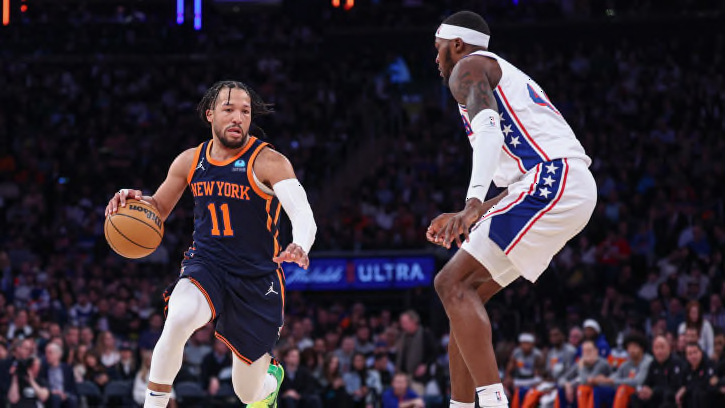
Danilo Gallinari has yet to become a consistently diverse scorer in the NBA. (Jesse D. Garrabrant/NBAE via Getty Images)
Knicks forward Danilo Gallinari has a lot going on right now. He’s getting over some lingering health issues that clearly affected his game, he’s mired in a vicious shooting slump and a decent portion of his team’s fan base would happily see him off to Denver in exchange for Carmelo Anthony. So forgive Gallinari for being a bit emotional.
Even so, his comments to Howard Beck of The New York Times struck me as unusual — particularly because Beck emphasized that Gallinari offered them unprompted:
“I know you expect a lot from me, and people expect a lot from me,” Gallinari said late Wednesday night, “but I’m not a superstar, I’m not an All-Star, I’m not LeBron, I’m not those great players. I’m an important player of the Knicks. And that’s what I’m trying to do, to help the team every time.”
Gallinari is right: He’s not LeBron James and he’s not an All-Star-level player. And Knicks coach Mike D’Antoni told Beck that the comments don’t necessarily mean Gallinari won’t become an All-Star player — just that he isn’t one now.
Still, it’s rare for a player to so publicly acknowledge his limitations, particularly one with such potential.
The interesting thing about Gallinari is how far, stylistically, he is from a typical All-Star player. The elite usually use a lot of their team’s possessions. They take a lot of shots, get to the line a ton and turn the ball over more than average players. They are stars because they can take on such a huge burden without becoming inefficient. There’s no doubt Kobe Bryant could shoot 50 percent if he took only open jumpers and cashed in on transition dunks. Bryant is a star because he can take 20 difficult shots and still shoot 45 percent.
Gallinari has never assumed anything close to that sort of burden in his two-plus seasons in New York. He is using only 19.2 percent of New York’s possessions this season. Since there are five guys on the court, that usage rate is about what we’d expect from an average player. Star players come in around 30 percent. Gallinari has been, to a large extent, a spot-up shooter. And he’s been a good one: He averaged 14.9 points per game as a rookie (with a 16 percent usage rate) and 16 points last season (19.3 percent usage rate. It’s hard to put up those kinds of numbers when you’re using just one-fifth of your team’s possesions.
In fact, since the 1999-2000 season, only 19 guys have gone through seasons in which they’ve averaged 15 points with a usage rate below 20 percent. (One player, Shawn Marion, has done it twice; every other player on the list has done it just once.) There are some big names on the list, but if you look closely, they fall into a few categories:
• The spot-up shooter, often aging. This is the most common type of player here, with aging versions of Peja Stojakovic, Reggie Miller and Michael Finley, as well one-dimensional spot-up guys such as Wesley Person and late-career Morris Peterson. These guys had basically one job: Shoot threes and stay out of the way otherwise. The 23-year-old, Phoenix-era Joe Johnson — also on this list — wasn’t so one-dimensional, but he was a young guy on a team that shot a ton of threes and relied on Steve Nash to do all the creating.
• Role-playing big guys. This includes 34-year-old Anthony Mason, Brad Miller when he was working out a role for himself during the bitter end of the unfulfilled Kings dynasty, and a non-shooter in Danny Fortson.
• Creative scorers. This is where Marion comes in, a freak of a player who, during his prime, found ways to score without being involved in offensive sets. That covers nearly all of the list, with a few weird exceptions — John Salmons last season and a young Richard Jefferson, for instance.
Either way, these are not star players, and they are the guys whom Gallinari, at this early stage in his career, most closely resembles. It is unknown whether Gallinari can step into a larger offensive role and maintain his efficiency — and that’s the exact thing I’d want to know if I were looking at Gallinari as the centerpiece in any Anthony deal.
As Beck points out, Gallinari came to the United States with the reputation as a creative scorer and much more than a spot-up three-point shooter. The Knicks certainly hoped he’d become something more when they picked him sixth in the 2008 draft. And he has gotten to the line more already this season; he’s attempted at least eight free throws in each of New York’s last five games, and he shot 17 in a win over the Kings on Wednesday. Those five games have included contests against three of the league’s worst defenses (Sacramento, Houston, Minnesota) and one of the league’s most foul-prone teams (Denver).
Can he keep up the diverse scoring against better defenses? If he does, it might be the first step in Gallinari’s becoming something he insists he’s not.

SI.com/NBA is part of the NBA.com Network. The NBA.com Network is part of Turner - SI Digital, part of the Turner Sports & Entertainment Digital Network.