Carmelo and the franchise-player debate

Decrease fontDecrease font
Enlarge fontEnlarge font

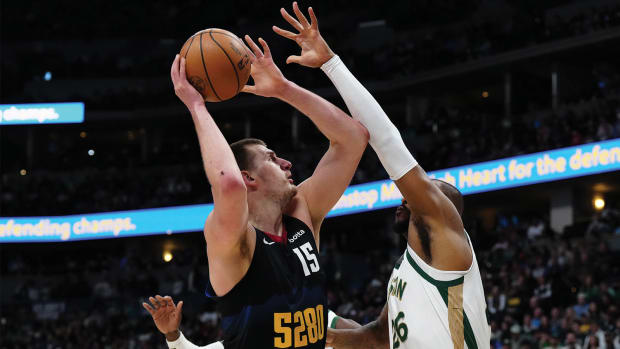
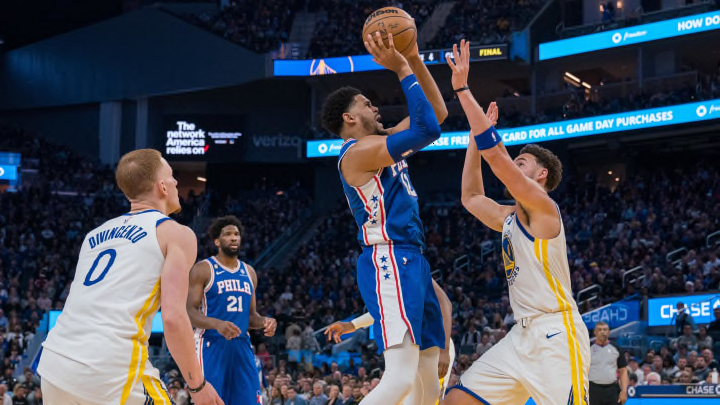
A contested shot from Carmelo Anthony is a familiar sight. (NBAE via Getty Images)

Carmelo Anthony is a gifted scorer, but statistics — both advanced and traditional — show he’s an inefficient scorer. His field-goal percentage is a tad below the league average, Denver’s fast pace inflates his pure point totals and his offensive rating, which measures how many points a player produces per 100 possessions, is right at the league average.

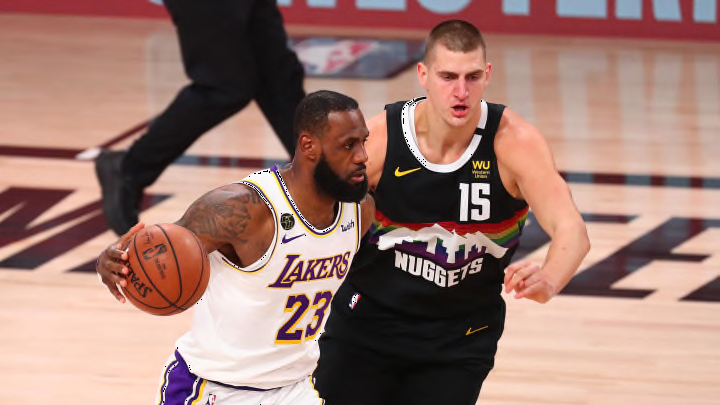
And yet, we have all spent the better part of the offseason talking about Anthony as if he were a franchise player, if not on the level of Kobe Bryant, LeBron James, Dwyane Wade or Kevin Durant, then certainly right at the top of the next subset of players. But the stats — other than pure scoring average — don’t bear that out.

As this debate unfolded, I kept thinking back to the 2009 playoffs, when — as I remembered it — Anthony was a singular force who was largely responsible for Denver’s coming within a couple of Trevor Ariza steals of pushing the Lakers to seven games in the Western Conference finals. I had certain images of that series: Anthony’s getting to the line at will; Anthony’s D-ing up on Kobe Bryant; Anthony’s working hard for rebounds on the low block.

This morning I looked up his stats from that series: 27.5 points per game on 40.7 percent shooting, including a 25 percent clip from three-point range on a Baron Davis-like 4.7 attempts per game. And those rebounds? Try 4.8 per game, one more than Chauncey Billups‘ average for that series. (Anthony did get to the line 12.5 times per game, which is crazy.)

My eyes saw something in Anthony that the stats didn’t back up.

Jeremy Wagner writes the Denver Nuggets blog Roundball Mining Company, and he had a similar eyes-versus-stats disconnect. So he cued up 10 games worth of videotape of Anthony and five other top perimeter scorers to see why this fantastic shot-maker ends up being so much less efficient than many other elite players. (The other scorers in Wagner’s sample: Kobe, Durant, LeBron, Wade and Kevin Martin — the last of those chosen because of his annually insane efficiency).

I implore you to go read Wagner’s post. It is an outstanding piece of work, filled with easy-to-digest charts and the usual great writing. The upshot is this: Anthony takes many, many more contested shots than those other five guys and, as it would have to be, many fewer open looks. Example: Only 39 percent of Carmelo’s shots in Wagner’s sample were classified as “open,” meaning no defender was within an arm’s length upon release. That was the lowest open-looks percentage in Wagner’s study; Martin had the highest, with 69 percent of his shots classified as open.

The sad part is that Anthony hit a higher percentage of his open looks than anyone Wagner studied, and he hit a decent chunk of his contested looks, too. He’s clearly a great shot-maker, but he’s taking too many bad shots.

We all know the classic Anthony bad shot: He catches the ball on the right wing with his defender in front of him, takes a couple of jab steps and launches a 20-footer. He also tends to drive into traffic at the rim, resulting in a lot of blocked shots and a declining shooting percentage on in-close field-goal attempts, according to Hoopdata. There’s also this: In 2006-2007, about 59 percent of Anthony’s baskets came as the result of teammate assists, according to Hoopdata. In 2007-2008, that figure was about the same: 58 percent.

But something started to happen in 2008-2009, when just 48 percent of Anthony’s buckets came after teammate assists, and that figure dropped to 41.6 percent last season. That’s still much higher than assisted-on rates for guys like LeBron and Wade, but those two are essentially point guards who create for themselves and others. Anthony has a point guard — Billups — who should be able to create looks for him. Overall, Denver’s offense ranked 20th in team-assist rate.

What’s going on here? This is a complicated situation, and any comprehensive answer would have to look both at the coaching staff’s offensive strategy and Anthony’s willingness to move away from isolations. During the first round of last year’s playoffs, Kevin Arnovitz of ESPN.com noticed an interesting thing: Denver was absolutely shredding Utah with pick-and-rolls, but the Nuggets rarely ran them, choosing instead to rely on isolation-heavy sets their coach at the time, Adrian Dantley, characterized as “random basketball.” Arnovitz had a simple question for Dantley: If the team knew it was more efficient on pick-and-rolls than in “random” iso sets, why didn’t Denver run more pick-and-rolls?

Dantley’s response:

“Statistically, we’ve had success on pick-on-rolls. We’ve told them that. We want them to do that tomorrow. Hopefully they do it. But, the last five years, we do more ‘random’ than we do pick-and-roll.”
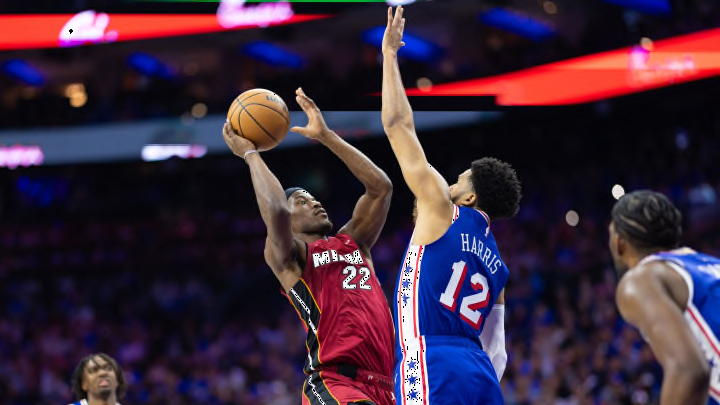
Whoa. Either the players were breaking plays or the coaching staff decided to rely on sets with which the team was most comfortable. And those sets have worked well. Denver had the third-most efficient offense last season, largely because it drew fouls more often than any other team. Isolation drives are good for drawing fouls.

But Denver’s offense might reach another level if the team relied less on isolations and more on off-the-ball movement, pick-and-rolls and other ways to spring guys for open looks. And it might need to reach that level when it runs into an elite defense skilled at avoiding fouls — precisely the sort of defense the Lakers play.

Anthony might thrive in that sort of offense if he’s willing to adapt, but teams interested in acquiring him have to wonder how interested he is.

  • Published On 3:08pm, Oct 19, 2010